
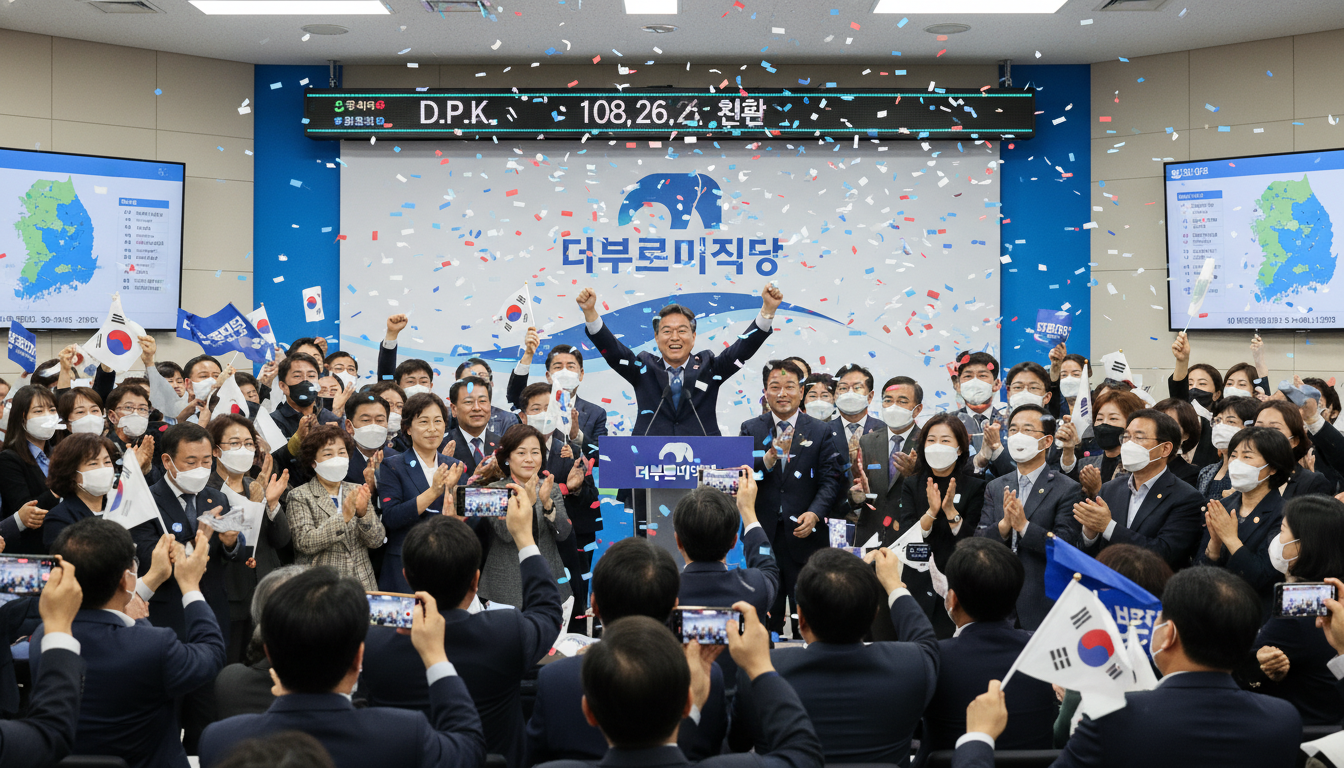
South Korea local elections deliver strong showing for ruling party, exit polls suggest
Exit polls from June 3, 2026 show the ruling Democratic Party outperforming expectations in South Korea local elections, with the Seoul mayoral contest closely watched.
Exit Polls Show Ruling Party Surge
Exit polls released after voting on June 3, 2026 indicated a clear advance for the ruling Democratic Party across multiple regions in the South Korea local elections. Broadcasters reported that the party picked up significant local offices, a result seen as an early assessment of President Lee Jae Myung’s administration. Analysts said the scale of the gains exceeded many pre-election forecasts and pointed to shifting voter sentiment since the last national contests.
The exit-poll advantage was particularly visible in metropolitan areas and several provincial capitals, according to preliminary tallies. While final official results were pending at the close of reporting, party strategists hailed the outcome as validation of recent policy priorities and campaigning efforts.
Seoul Mayoral Race Remains Focal Point
The mayoral race in Seoul drew concentrated attention as the most politically consequential contest of the day. The two leading contenders, Chong Won-o of the Democratic Party and Oh Se-hoon of the main opposition People Power Party, were neck-and-neck in media projections. Observers framed the Seoul result as both a test of local leadership and a referendum on national politics.
A Democratic Party victory in the capital would bolster the ruling party’s claim of renewed public support, while an opposition win would underscore lingering challenges for President Lee. Voter decisions in Seoul were expected to influence political narratives and campaign strategy ahead of future parliamentary and presidential cycles.
Implications for President Lee Jae Myung
Political operatives on both sides interpreted the South Korea local elections as a barometer for President Lee Jae Myung’s performance in office. The ruling party’s apparent gains were read as a measure of approval for the administration’s policy mix, including economic and social initiatives introduced since the president took office. Supporters argued the results gave the government stronger mandate to press ahead with its agenda.
Opposition leaders cautioned against overinterpreting exit polls and emphasized that long-term trends would depend on policy outcomes and how teams respond to local governance challenges. For President Lee, the immediate task will be to translate electoral momentum into concrete achievements at the municipal and provincial level.
Turnout Patterns and Regional Variations
Voter turnout and regional patterns shaped the overall picture of the South Korea local elections. Early reports suggested turnout varied between urban centers and rural districts, with demographic factors influencing party performance across age groups. Some regions saw tight contests, reflecting local issues such as housing, transportation, and municipal services.
Political analysts noted that younger voters and metropolitan residents were pivotal in swinging key races. Meanwhile, conservative strongholds in certain provinces continued to provide a base for the People Power Party, preventing a uniform sweep by the ruling party.
Reactions From Parties and Civic Groups
Democratic Party officials responded to the exit-poll results by pledging to strengthen local governance and accelerate deliverables promised during the campaign. Party spokespeople highlighted the need to convert provisional gains into sustained administrative success at the municipal level. The People Power Party expressed concern but framed outcomes as motivation to regroup and sharpen policy messaging.
Civic groups and business associations issued measured statements urging newly elected local leaders to prioritize practical solutions for housing affordability, business regulation, and public services. Observers emphasized the importance of cooperation between national and local governments to ensure effective implementation of policies.
Next Steps and Official Certification
With exit polls suggesting a decisive day for the ruling party, attention turned to official counts and the certification process that follows. Election authorities began the formal tallying of ballots and verification of results that will determine final officeholders. Legal timelines for challenges and audits were noted by campaign teams preparing for any close or contested races.
Political strategists said both parties would use the detailed precinct-level results to inform approaches for upcoming national contests. The immediate weeks after the local elections are likely to see intensified activity as winners set priorities for their first months in office.
The South Korea local elections on June 3, 2026 produced results that political actors will study closely as they plan for the next stages of governance and campaigning. Final certified outcomes and post-election analyses will shape interpretations of voter intent and the prospects for both the ruling Democratic Party and the opposition People Power Party in the months ahead.

