
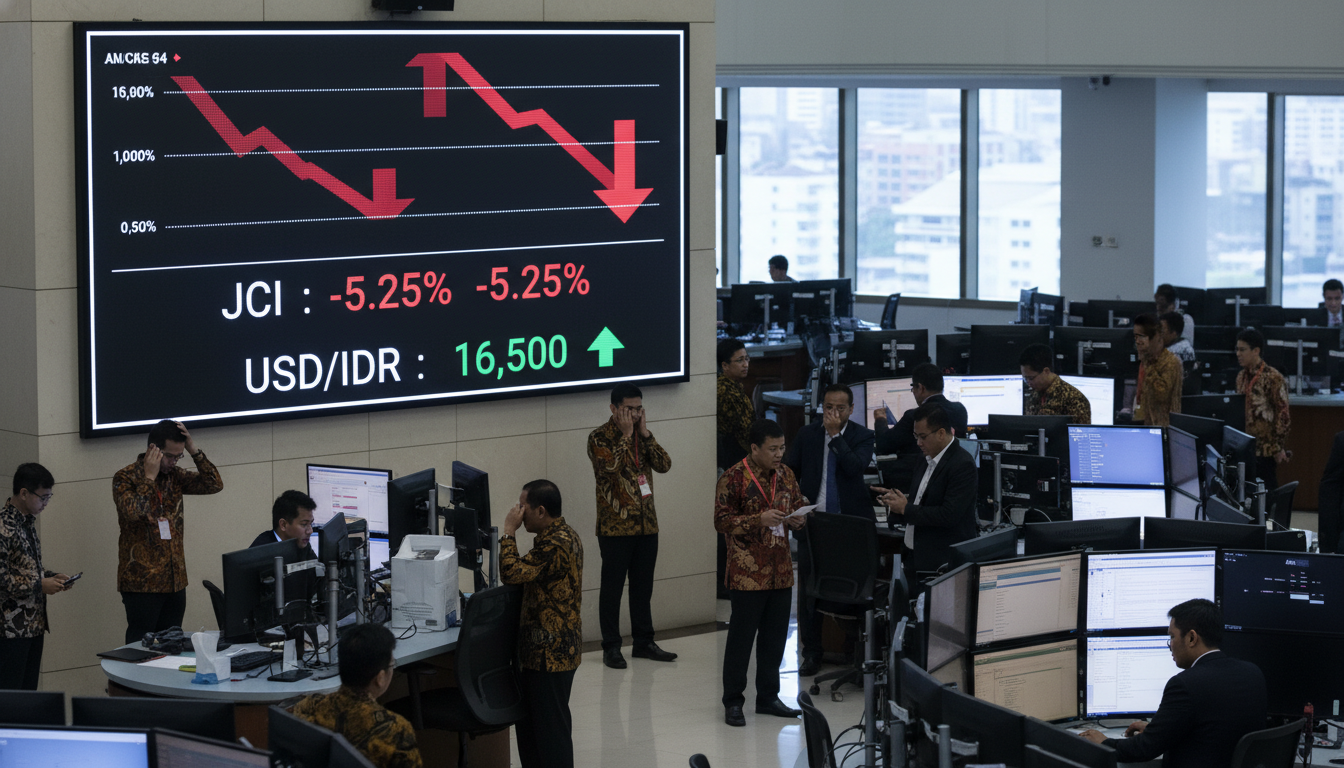
Jakarta Composite Index Falls to Five-Year Low as Rupiah Slides and Export Controls Stoke Investor Fears
Jakarta Composite Index tumbles to 5,855 on June 3, 2026, as a weakening rupiah and fresh export controls deepen market unease
The Jakarta Composite Index plunged to a five-year low of 5,855 on June 3, 2026, as a depreciating rupiah and investor worries over recent export controls and fiscal strains combined to sap confidence in Indonesian equities. Market participants cited rising uncertainty about government policy toward commodity exports and the potential for further capital outflows as key drivers of the sell-off. Trading volumes rose as foreign investors accelerated withdrawals, while domestic investors weighed the economic implications of new state-backed measures announced in recent weeks.
Jakarta Composite Index hits five-year low
The benchmark Jakarta Composite Index fell sharply in early trading on June 3, reaching a level not seen since 2021 and signaling renewed stress in the domestic market. The decline reflected broad-based selling across cyclical sectors that are sensitive to changes in export rules and currency volatility. Analysts said the index’s drop underscored how policy developments and currency moves can quickly translate into equity-market weakness in Indonesia.
Volatility has returned to the market after a period of relative calm, with headline moves amplified by limited liquidity in some mid- and small-cap names. Market strategists noted that sentiment shifted abruptly as investors reassessed exposure to sectors likely to be affected by tighter export management and an uncertain fiscal backdrop.
Rupiah weakness and capital outflows
The rupiah’s sustained slide against the U.S. dollar intensified pressure on the stock market, increasing the local-currency value of foreign selling. Currency depreciation raised concerns about imported inflation and corporate balance sheets that carry dollar-denominated debt. Investors said the combination of a weaker rupiah and rising global yields made Indonesian assets less attractive to overseas portfolio managers.
Capital outflows accelerated as international funds rebalanced portfolios toward perceived safer assets amid higher global risk aversion. Domestic institutional investors reported a more cautious stance, preferring cash or short-duration instruments until policy signals clarified. The interaction between currency moves and equity flows created a feedback loop that pushed the benchmark lower.
New export controls deepen investor unease
Investor sentiment was further unsettled by the recent establishment of a state-backed body charged with managing exports of key commodities, a move that traders said could portend tighter controls or longer-term market interventions. Officials framed the measure as a way to secure domestic supply and stabilize prices, but market participants worried about potential disruptions to export revenues and the predictability of trade rules.
Companies in sectors reliant on commodity exports faced immediate reassessment of earnings prospects, with investors factoring in the risk of quotas, licensing changes, or other administrative restrictions. Analysts highlighted that the announcement increased regulatory uncertainty at a time when global demand remains uneven, complicating forecasts for export-dependent firms.
Fiscal concerns and policy ambiguity
Beyond export measures, broader fiscal pressures contributed to the market downturn as investors scrutinized government spending plans and debt dynamics. Questions about the pace and composition of fiscal support, as well as the interplay between fiscal policy and monetary normalization, created ambiguity for fixed-income and equity investors alike. Some market participants flagged the possibility of higher borrowing needs if authorities intervene to support domestic prices or strategic industries.
Policy communications that lacked clear forward guidance heightened the sense of risk, prompting calls from analysts for more transparent and predictable frameworks. Market watchers emphasized that clear timelines and rules around export management and fiscal adjustments would be critical to rebuilding investor confidence.
Market outlook and analyst forecasts
Strategists forecasting the near-term market path cautioned that volatility could persist until policy intentions are clearly articulated and the rupiah stabilizes. Short-term scenarios range from a gradual recovery if authorities provide reassurances, to further downside should capital outflows continue and regulatory measures tighten. Several brokerage reports recommended defensive positioning while advising investors to monitor liquidity trends and currency movements closely.
Longer-term outlooks remained mixed: some analysts argued that Indonesia’s underlying fundamentals—large domestic market, commodity endowments and structural reforms—still offered attractive prospects, while others said the timing and execution of policy changes would determine investment returns. Market participants said the next few weeks would be pivotal, with corporate earnings releases, any new regulatory announcements, and central bank commentary likely to shape sentiment.
The coming days will be watched closely for signals from policymakers and central bank authorities on steps to stabilize the currency and clarify trade rules.
Despite the recent drop in the Jakarta Composite Index, some domestic investors saw selective opportunities in companies with strong balance sheets and limited exposure to export-related regulatory risk. Market recovery will depend on a combination of clearer policy communication, currency stabilization, and the return of foreign investor appetite.

