
Shinjuku Station: navigating Tokyo’s busiest transport hub
Shinjuku Station remains Tokyo’s most crucial rail hub, handling millions of passenger movements daily and serving as a gateway to the city’s major commercial, entertainment and transport links.
Shinjuku Station continues to be central to Tokyo’s transport network and daily life, with its layered platforms, sprawling exits and a network of connections that link local, regional and limited‑express services. The station’s scale and complexity make it both indispensable and intimidating for first‑time visitors and habitual commuters alike. This guide explains the station’s layout, transit options, facilities and practical tips for navigating one of the world’s busiest rail complexes.
Passenger volumes and historical context
Shinjuku Station’s rise from a modest stop in the late 19th century to a metropolitan hub reflects Tokyo’s broader urban development over the last century. What began as a small single‑line stop has expanded to accommodate multiple private railways, JR East services and several municipal subway lines, creating a complex spread across several basement and street levels.
The station’s passenger volumes are among the highest in the world, a status rooted in decades of commercial growth, post‑disaster migration and urban redevelopment in the surrounding wards. Its function as a transfer node between local commuter lines, regional limited‑express services and surface transport keeps daily footfall extremely high and places continual pressure on station wayfinding and passenger facilities.
Longstanding developments — such as the opening of private lines in the early 20th century and major postwar reconstruction projects — shaped the modern footprint of Shinjuku Station. Those changes also drove the cluster of department stores, office towers and entertainment districts that now sit within easy walking distance, reinforcing the station’s role as a focal point for both travel and urban life.
Layout and major exits of the station
Shinjuku Station is arranged across multiple levels, combining surface platforms, mezzanine concourses and deep basement lines, with well over thirty platforms serving different operators. The station’s design divides it into distinct zones — East, West and South — each linked by underpasses, concourses and multiple numbered exits that can be several minutes’ walk apart.
Key level designations include basement concourses that give access to ticketing and subway entrances, ground‑level platforms for some JR services, and upper concourses that connect to adjacent shopping complexes. Certain subway platforms lie deep underground and are signed as separate stations for operational purposes, even though they are integrated into the broader Shinjuku complex.
For visitors the most important navigation point is the exit rather than the platform number. East Exit leads toward the business and shopping quarter and is the route to many department stores and corporate offices. West Exit directs passengers to entertainment areas and hotel clusters, while the South Exit is the principal gateway to highway bus terminals and major commercial developments.
Train, subway and limited‑express services
A wide array of JR services stop at Shinjuku Station, including inner‑city lines used by commuters and longer‑distance rapid services that link the west of Tokyo with central districts. The station sits on several JR corridors that circulate passengers across the metropolitan area and beyond, providing frequent service on major commuter routes.
Multiple private rail operators serve the station as well, bringing passengers to suburban destinations and to regional leisure spots. These lines operate side‑by‑side with subway services run by Tokyo Metro and the municipal Toei network, so a single journey may involve transfers between different companies at the same complex.
Limited‑express trains and airport services call at Shinjuku as well, offering direct connections for travelers headed to regional cities and international gateways. While Shinjuku is not a Shinkansen terminal, the station’s JR links provide efficient transfers by rapid or commuter services to Tokyo Station and Shinagawa Station where bullet trains depart.
Bus terminals, highway routes and airport connections
Shinjuku functions as more than a rail interchange; it is a central hub for local buses, sightseeing circuits and long‑distance highway coaches. The expressway bus terminal located near the South Exit handles routes to key destinations across Honshu, including major tourist centers, regional airports and long‑haul overnight services.
Local municipal buses operate from dedicated stops near the West Exit and circulate through the surrounding wards, serving major hotels, district attractions and transfer points. Sightseeing buses and dedicated day‑trip services also depart from the station area, providing a convenient alternative to rail for certain routes and destinations.
Airport access is straightforward from Shinjuku, with dedicated limousine coach services linking the complex to Haneda and Narita airports. Travelers can also reach the airports via a combination of commuter and limited‑express trains, or by transferring to trunk rail lines that serve the Shinkansen and rapid airport connections from nearby stations.
Facilities, lockers and ticketing services for travelers
Shinjuku Station houses a broad range of traveler facilities designed to handle the needs of high volumes of passengers, including staffed ticket offices, automated vending machines, travel centers and foreign currency exchange counters. These services are concentrated near the principal concourses so that passengers making connections or booking onward travel can access assistance quickly.
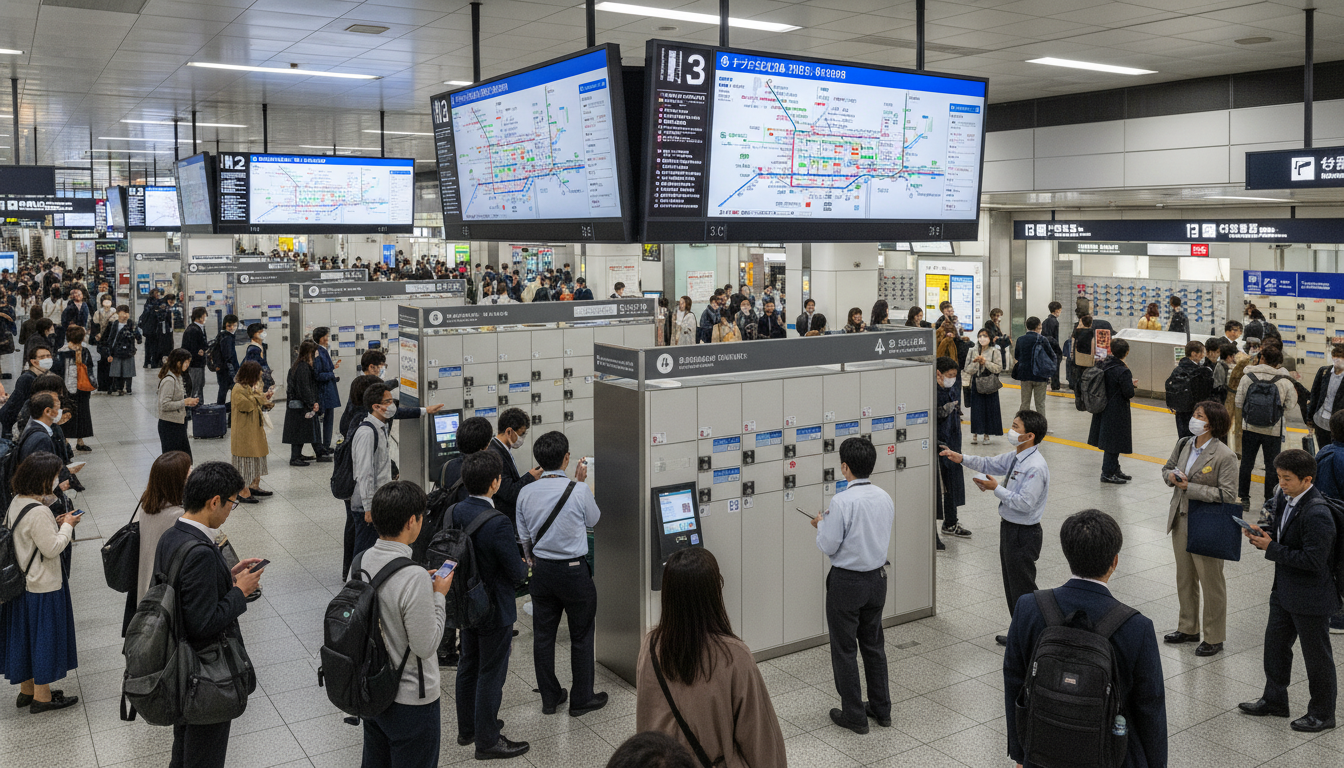
Short‑term luggage storage is widely available in the form of coin and electronic lockers, but they tend to reach capacity quickly during weekends and peak travel periods. For visitors carrying large bags, station‑linked delivery services and off‑site luggage apps provide alternatives that enable travelers to move through the station without encumbrance.
Accessibility has been improved through the installation of elevators, accessible toilets and step‑free routes to a growing number of platforms and exits. Information centers and multilingual signage help international visitors, but travelers who are unsure about transfers or ticketing options will still find it beneficial to consult the station’s staffed counters during busy times.
Practical navigation advice and peak‑time strategies
Navigating Shinjuku Station is easier when you plan your exit in advance and follow the major concourse signs rather than trying to find a specific numbered gate. Digital maps and journey planners are useful for identifying which exit to use, but inside the station it is often faster to follow directional signage to the East, West or South gates and to ask staff at information counters when in doubt.
Avoiding weekday rush hours if possible will make transfers and movement through the concourses significantly less stressful, particularly during the morning and evening peaks when platforms and passageways fill quickly. When commuting during busy periods, stay to the side on stairs and walkways to let faster traffic pass, and allow extra time for transfers that require walking between concourses.
If you must connect to services at other major terminals, such as Tokyo Station or Shinagawa, plan that transfer ahead and give yourself a buffer for ticketing and walking time. Using IC cards simplifies gate passage and reduces the need to queue at ticket machines, and purchasing day passes for subway travel can be cost‑effective for short visits with multiple trips.
Shopping, dining and nearby attractions beyond the concourses
Beyond its transport role, Shinjuku Station acts as a shopping and dining nucleus, with department stores, underground malls and food halls directly connected to the concourses. Retail complexes adjacent to the station offer everything from convenience stores and quick‑service restaurants inside the gates to higher‑end dining and boutique shops within connected department stores.
Outside the exits, the surrounding neighborhoods provide a wide range of leisure options. East of the station visitors will find major shopping districts and high street brands, while the areas to the south and west are home to entertainment districts, small alleyway bars and a selection of cultural attractions such as urban gardens and observation platforms.
For visitors with limited time, the station’s interconnected shopping arcades and department floors allow for quick browsing between trains, while nearby green spaces and landmark observation decks make excellent short excursions for first‑time visitors seeking a contrast with the station’s bustle.
Shinjuku Station is a study in urban scale, combining intense passenger flows with an extensive array of services and neighborhood connections. With a little preparation — knowing which exit you need, avoiding peak crowding where possible, and using the station’s traveler services — visitors can move through the complex efficiently and make the most of the retail and cultural offerings that lie just beyond its gates.

