
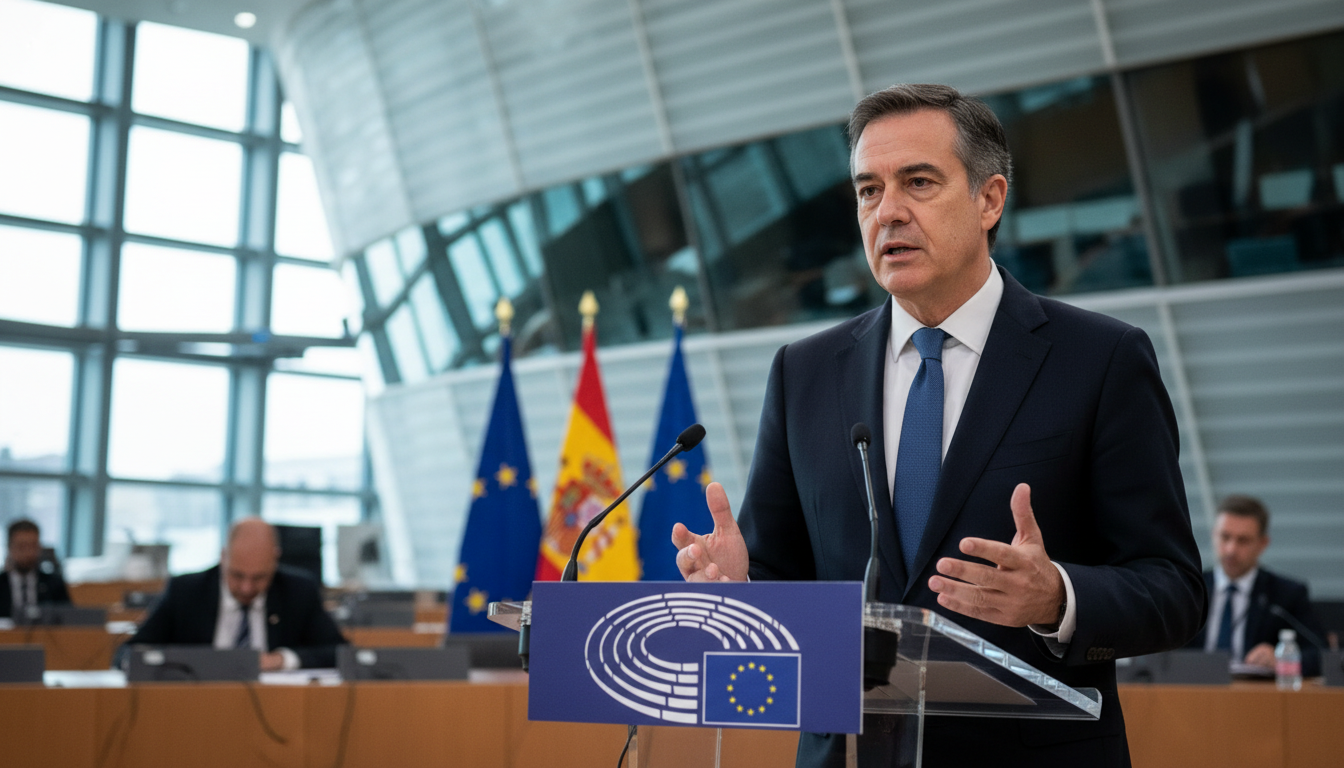
Spain Warns EU Credibility at Risk over Israel’s ‘Perpetual War’ in Gaza
Spain warns EU credibility is at stake if it applies different standards to Israel than to Russia; minister urges united action and human-rights enforcement.
Spain’s foreign minister warned on April 21, 2026, that EU credibility is at risk if the bloc does not apply the same principles to Israel’s campaign in the Middle East as it has to Russia’s invasion of Ukraine. He urged European partners to adopt a unified stance and pointed to human-rights clauses in the EU–Israel agreement as a basis for action. The minister described rising violence in Gaza, the West Bank and Lebanon as evidence that inconsistent policies could undermine the EU’s global standing.
Spain’s warning to the European Union
The Spanish foreign minister framed his intervention as a call for consistency in EU foreign policy on April 21, 2026. He argued that the bloc’s response to protracted hostilities involving Israel should follow the same human-rights and rule-of-law standards applied to other conflicts. The comments came amid continuing reports of civilian suffering across multiple fronts of the Israel–Palestine conflict and cross-border tensions with Lebanon.
He stressed that failure to apply agreed principles uniformly risks eroding trust in the EU’s ability to defend its stated values. Madrid’s intervention signals pressure within the Union for clearer policy guidance and a more coordinated diplomatic approach. The statement was couched as a diplomatic appeal rather than a formal call for immediate punitive measures.
Human-rights clauses in the EU–Israel agreement
The minister referenced human-rights conditionality embedded in the EU’s agreements with partner states to underline his point. Such clauses typically allow the Union to review cooperation or take measures if serious violations are alleged. Citing those provisions, he urged EU institutions to consider whether existing ties with Israel require reassessment in light of ongoing violence.
Legal and diplomatic experts within Brussels and member states have long debated how and when to invoke conditionality without jeopardizing channels for dialogue. The minister’s comments place fresh attention on those mechanisms and the thresholds for their activation. His appeal suggests Madrid views the clauses as operational tools, not merely symbolic language.
Patterns of violence in Gaza, the West Bank and Lebanon
Officials in Madrid singled out hostilities across Gaza, the West Bank and along the Israel–Lebanon frontier as the context for the warning. The foreign minister described the situation as a form of “perpetual war” that, in his view, warrants a consistent EU response. He highlighted the humanitarian impact and the risks of escalation that could destabilize the wider region.
Diplomats and analysts note that cyclical violence, cross-border exchanges, and militia involvement complicate the EU’s ability to craft a single policy. The minister’s remarks reflect concern that differing responses among member states could produce a fragmented external posture. That fragmentation, he warned, would be detrimental to the bloc’s influence in Middle East diplomacy.
Calls for a unified EU stance
Spain pressed fellow EU capitals to align their positions and avoid selective enforcement of standards. The minister urged coordination through EU foreign-policy bodies to ensure statements, sanctions, and diplomatic steps are consistent with the Union’s stated commitments. He argued that fragmented messaging weakens both the moral and practical leverage the EU can exert.
Some member states have historically been reluctant to equate responses across distinct geopolitical contexts, citing strategic, historical and security ties. Madrid’s intervention seeks to shift the debate toward principle-based policy that can be sustained across different bilateral relationships. The call underscores growing tensions within the EU over balancing values, strategic interests and regional stability.
Diplomatic and legal tools available to the EU
Analysts point to a range of instruments Brussels can deploy, from targeted sanctions and trade measures to suspension of parts of cooperation agreements. Human-rights clauses are intended to provide a lawful basis for such measures when serious breaches are documented. The minister’s reference suggests Spain expects the EU to at least review available options and signal seriousness in enforcing its standards.
At the same time, many diplomats caution that punitive measures carry diplomatic risks, including reduced leverage and the potential for retaliatory steps. The minister framed his recommendation as a path to preserve credibility, not as an automatic call for confrontation. He emphasized that consistency and predictability in the EU’s approach would enhance its capacity to mediate and support de-escalation.
Regional and international implications
Madrid warned that inconsistent EU responses risk diminishing the bloc’s role as a credible actor in international crises. The foreign minister suggested that if the EU is perceived as applying double standards, it may lose moral authority with partners in the Middle East and beyond. Such reputational damage could complicate the Union’s broader strategic objectives, including conflict resolution and humanitarian engagement.
Observers say the debate opened by Spain may prompt renewed consultations among EU foreign ministers and could influence statements at upcoming Council meetings. How member states balance immediate security concerns with long-term credibility will shape the Union’s posture in a fractious region.
Spain’s intervention marks a notable moment in the EU’s internal debate over foreign-policy coherence and human-rights enforcement. The minister’s appeal for consistency ties legal provisions in agreements to the political need for a unified response, and sets the stage for further discussions among EU capitals about how best to reconcile values, diplomacy and regional stability.

