
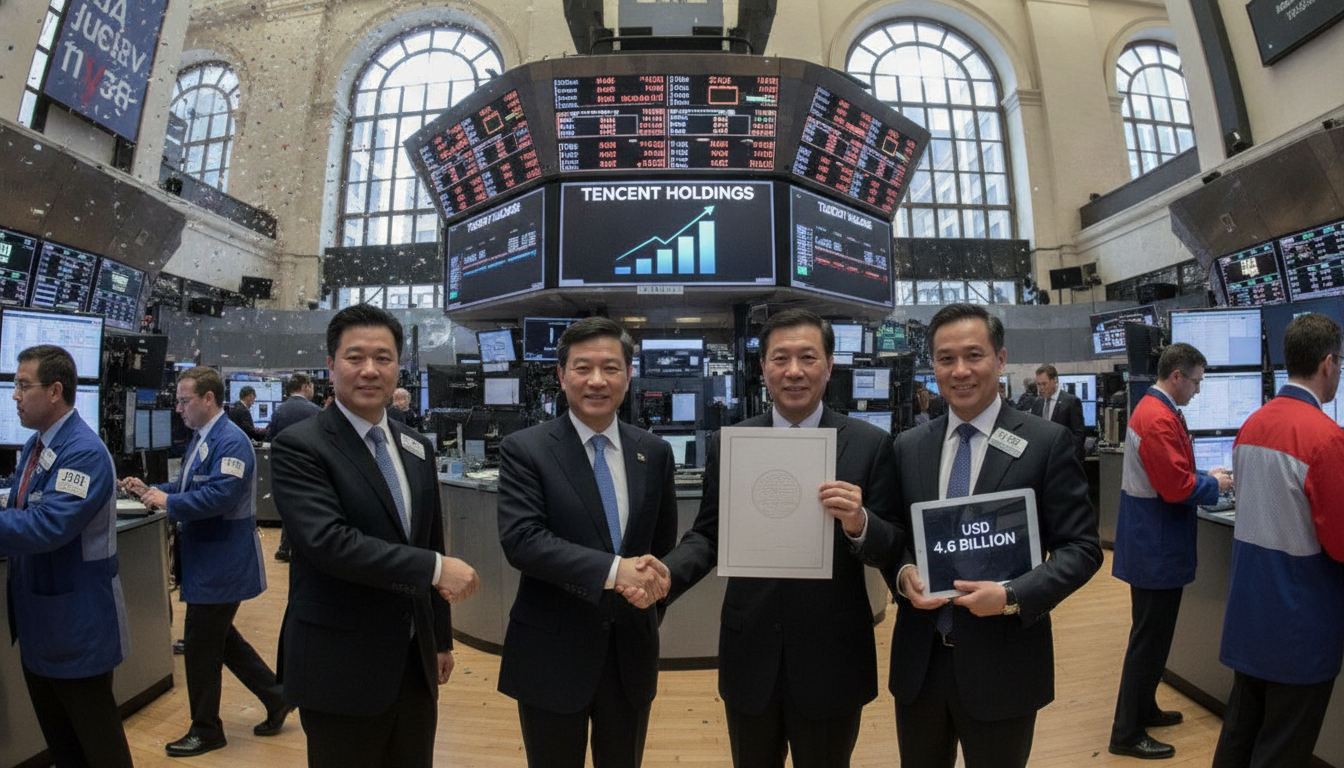
Tencent bonds raise about $4.6 billion in dual‑currency sale, first US dollar issue since 2021
Tencent bonds: Chinese tech titan raised roughly $4.6 billion through dual‑currency bonds—its first greenback issuance since 2021—to fund AI and business investments.
Summary of the offering
Tencent has raised approximately $4.6 billion through a pair of bond issuances, selling debt in both U.S. dollars and offshore yuan (CNH). The dollar tranche marks the company’s first greenback bond sale since 2021, a return to international dollar markets that drew attention from global investors. Tencent said proceeds will be used to support increased investments in artificial intelligence and other strategic businesses as competition with domestic rivals intensifies.
Composition and scale of the deal
The combined offering consisted of two separate tranches: one denominated in U.S. dollars and a parallel issue in offshore yuan. Together the transactions totaled about $4.6 billion, reflecting the issuer’s decision to tap multiple currency pools to broaden investor reach. Market participants noted the dual‑currency structure allowed Tencent to access both dollar liquidity and stronger demand among CNH investors.
Banks and book‑running arrangements
Major U.S. and international banks played lead roles in arranging and underwriting the offerings, reflecting continued willingness among global financial institutions to support large Chinese corporate issuers. Banker involvement helped distribute the bonds across institutional desks in Asia, Europe and the United States. Underwriting support and order books were cited as key to the success of the placement, particularly for the dollar tranche following a multi‑year absence from the U.S. dollar primary market.
Strategic purpose: AI and business investment
Tencent has signaled that the funds will be directed toward stepped‑up investment in artificial intelligence and expansion of its other core businesses. Management has emphasized AI as a priority area amid intensifying competition from ByteDance and Alibaba across advertising, cloud services and consumer platforms. The bond sale is therefore being interpreted as part of a broader capital‑allocation strategy to sustain product development and market share in key technology domains.
Market reaction and significance of the greenback return
The greenback issuance is viewed by analysts as a barometer of international investor appetite for large, state‑adjacent Chinese technology issuers. Issuing in U.S. dollars for the first time since 2021 sends a signal that Tencent sees favorable conditions in global credit markets and sufficient investor confidence in its balance sheet. The transaction also offers a datapoint for how China’s biggest tech groups can finance growth outside domestic capital markets after a period of regulatory tightening and heightened geopolitical scrutiny.
Implications for offshore yuan and corporate funding
The inclusion of an offshore yuan tranche underscores the growing role of CNH as a complementary funding channel for Chinese corporates seeking diversified investor bases. Offshore yuan issuance allows issuers to match funding with yuan‑denominated costs and to tap pockets of regional liquidity in Greater China and Southeast Asia. For investors, the dual‑currency structure provides choice in currency risk exposure and may help broaden secondary trading liquidity across both markets.
Outlook for Tencent’s financing and strategy
The bond placement gives Tencent additional near‑term financing flexibility as it steps up spending on AI, cloud computing and other strategic areas. How the company deploys the proceeds will be watched closely by investors assessing the pace and effectiveness of its investments amid stiff domestic competition. Future access to both dollar and CNH markets will likely depend on macroeconomic conditions, investor sentiment toward Chinese technology firms, and progress on Tencent’s operational priorities.
Tencent’s return to the dollar market and its sizable dual‑currency raise highlight the company’s active effort to secure long‑term funding while pursuing an aggressive technology and product roadmap. The transaction will be interpreted by markets as a test case for other large Chinese issuers considering a return to international bond markets.

