
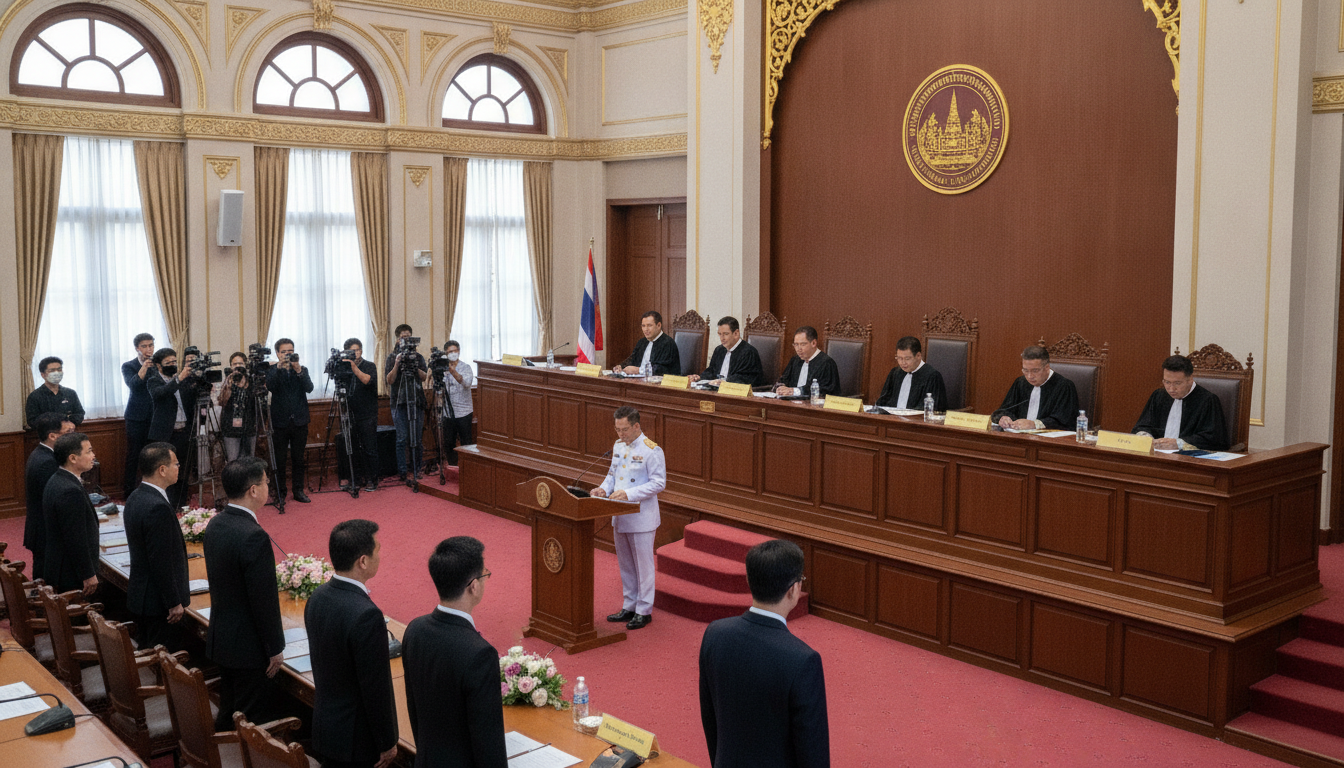
Thailand court upholds 400 billion baht emergency borrowing to fund household relief and energy plans
Thailand court upholds 400 billion baht emergency borrowing, clearing the way for household relief and energy-transition spending amid rising oil prices.
Thailand’s Constitutional Court on Thursday ruled that the government’s emergency decree to borrow 400 billion baht is lawful, removing a key legal obstacle to measures designed to soften the impact of rising fuel costs. The decision clears the way for immediate household aid measures and for planned spending on energy-transition projects tied to the fiscal package. The ruling comes as global oil prices have been pushed higher by the Middle East conflict, creating pressure on households and public finances.
Court ruling clears emergency borrowing
The court found the emergency borrowing decree complied with legal and constitutional requirements, allowing the cabinet to proceed with its financing plan without further judicial impediment. Judges said the exceptional circumstances cited by the executive met the threshold for an emergency fiscal measure, permitting the government to temporarily step outside normal budget procedures. The decision provides legal certainty for ministers to finalize allocations and begin disbursing funds.
Household relief to be prioritised amid fuel shock
The government has signalled that a substantial share of the 400 billion baht package will target households facing higher household energy and transport costs. Officials intend to roll out targeted cash support, subsidies for fuel and electricity, and temporary price relief programs aimed at low- and middle-income families. Authorities say the immediate goal is to stabilise living costs while the energy market reacts to geopolitical tensions that have driven international crude prices upward.
Energy-transition spending tied to borrowing plan
Beyond short-term relief, the borrowing is also earmarked for measures linked to Thailand’s longer-term energy transition, including investments in renewable generation and efficiency upgrades. Cabinet documents outline funding for grid reinforcement, incentives for rooftop solar and other low-emission technologies, and pilot projects to reduce reliance on imported fossil fuels. Officials argue that combining near-term relief with transition spending will both cushion consumers today and reduce vulnerability to future price shocks.
Prime minister and parliamentary context
Prime Minister Anutin Charnvirakul, who has defended the emergency decree in parliament, welcomed the court decision as a necessary step to protect voters from rising costs. The coalition government framed the borrowing as a pragmatic response to an external shock rather than an expansionary fiscal policy. Lawmakers debated the measure in recent weeks, with proponents stressing speed and opponents warning about fiscal discipline and transparency.
Opposition concerns and oversight demands
Opposition parties and some fiscal watchdogs have expressed reservations about the size of the emergency borrowing and the speed at which funds will be deployed. Critics pressed for clearer details on eligibility for household aid, independent auditing of disbursements, and guardrails to ensure that a portion of the funds actually advances energy-transition objectives. In response, the finance ministry pledged to publish regular expenditure reports and to seek parliamentary oversight as funds are released.
Economic implications and market reaction
Economists say the borrowing will provide short-term relief but carries medium-term fiscal implications that will need careful management. The injection of funds can blunt the immediate effects of higher fuel prices on consumption and inflation, yet it may widen the budget deficit in the current fiscal year. Market analysts will watch sovereign debt indicators and public debt trajectories to assess whether the temporary measure becomes recurrent spending pressure in future budgets.
Regional and international backdrop
Thailand’s move must be read against a broader regional context in which energy markets have been disrupted by the U.S. military confrontation with Iran, a development that has pushed crude oil prices higher. The government framed the borrowing as a defensive fiscal manoeuvre in response to this international shock rather than a domestic policy shift. Foreign investors and trade partners will follow how Bangkok balances immediate relief with commitments to medium-term fiscal stability and decarbonisation goals.
The court ruling effectively allows the government to begin implementing its emergency spending plan, and officials say disbursements to households and contracts for energy projects will start in the coming weeks. Policymakers have indicated they will pair emergency assistance with transparency and reporting measures to address criticism, even as they warn that continued global volatility could require further adjustments.

