
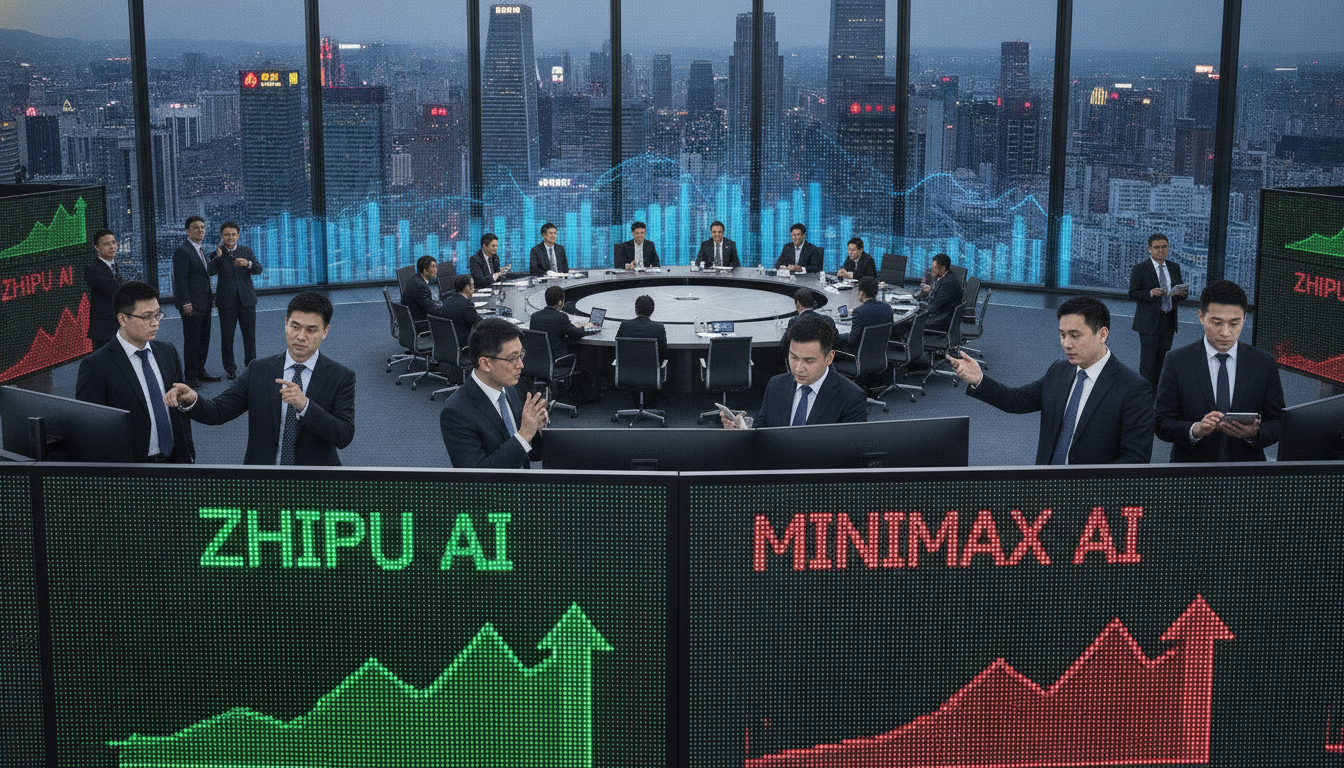
Zhipu valuation gap widens as shares surge while Minimax lags in Hong Kong AI rally
Zhipu valuation gap widens as the company’s shares surge in Hong Kong while rival Minimax lags; investors are growing selective in China’s heated AI market, partly due to state ties.
Zhipu Leads Market Rally; Minimax Trails
A widening Zhipu valuation gap has emerged as the company’s stock outperformed that of Minimax in recent trading sessions in Hong Kong. Market participants say Zhipu’s shares have attracted strong demand, lifting its market valuation notably ahead of its nearest large-language model competitor.
Minimax, meanwhile, has not seen comparable momentum, leaving a growing divergence between the two startups that are viewed as leaders in China’s large-language model sector. The gap is being interpreted by investors and analysts as a sign of selective enthusiasm within the broader AI rally.
Government Connections Boost Zhipu Investor Confidence
Observers point to Zhipu’s perceived ties to government projects and policy circles as a key factor behind the outperformance. Those connections are seen as enhancing Zhipu’s access to contracts and preferential support in domestic procurement, which can translate into revenue visibility.
Analysts caution that state links are not the sole explanation, but they note that in a market where policy alignment matters, such relationships can amplify investor appetite. The result has been a willingness among some institutional investors to assign a premium to Zhipu’s shares.
Market Dynamics and Investor Selectivity
The Zhipu valuation gap reflects a broader recalibration in the AI investment landscape, where gains are increasingly concentrated among firms with perceived strategic advantages. After an initial period of broad-based speculation, investors are shifting to a more discerning posture focused on defensible business models and near-term monetization.
This selectivity has led to sharper price dispersion among AI-focused listings, with companies that demonstrate clearer revenue paths or unique market positions receiving outsized allocations. Those lacking equivalent signals, including Minimax, have consequently seen more muted share price movement.
Comparative Business Signals and Risk Perception
Beyond political associations, market participants highlight differences in commercial partnerships, product maturity and enterprise customer traction as factors separating the two companies. Firms that can showcase recurring contracts, scalable deployment of models, or industry-specific offerings tend to be rewarded more by investors.
Risk perception also plays a role, with some investors viewing higher-profile ties as a double-edged sword that can bring both opportunity and regulatory scrutiny. The interplay between potential preferential access and the evolving regulatory environment for AI in China has made assessments more complex.
Implications for Hong Kong Listings and Capital Flows
The divergence between Zhipu and Minimax underscores the role of Hong Kong’s capital markets as a barometer for investor sentiment toward Chinese AI firms. The trading patterns reveal how capital flows are concentrating around a subset of companies perceived as having superior prospects.
For policymakers and exchange officials, the episode highlights the sensitivity of valuations to non-financial signals in a strategically important sector. For investors, it reinforces the need for granular due diligence when navigating a market still defined by rapid technological change and policy emphasis.
Analysts Urge Caution on Short-Term Volatility
Market analysts warn that the Zhipu valuation gap could remain volatile as headlines, data releases and policy statements continue to influence sentiment. Short-term trading dynamics may exaggerate gaps, and fundamentals will be tested as companies report results and disclose contract pipelines.
Investors are advised to weigh both the upside potential from AI adoption and the specific execution risks for each firm. Close monitoring of revenue trends, customer retention and regulatory developments will be essential to validate current market pricing.
The widening Zhipu valuation gap presents both opportunity and uncertainty for stakeholders tracking China’s large-language model sector. As investors become more selective, the performance differential between market favorites and laggards is likely to persist until clearer evidence of sustainable earnings trajectories emerges.

