
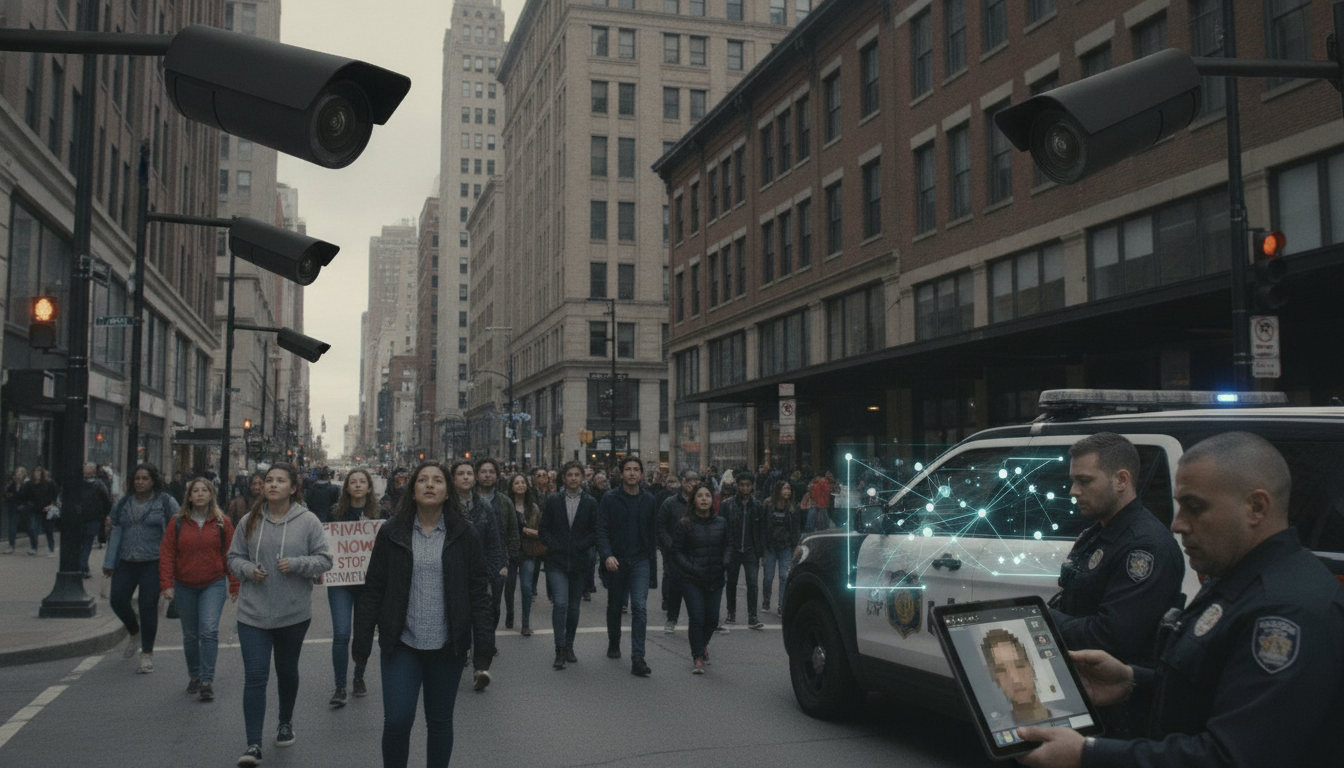
AI facial recognition cameras aid rescue but deepen privacy debate
AI facial recognition cameras used by police helped locate a woman in late March 2026, highlighting both life‑saving potential and growing public unease about surveillance. The incident, and how live facial recognition systems operate, has intensified debate in the UK and Japan about law enforcement use of biometric AI and the safeguards needed to protect citizens’ rights.
Live facial recognition used in riverbank rescue
In late March 2026, emergency responders credit a live facial recognition deployment with helping locate a middle‑aged woman found unconscious beside a river under a bridge. The system, operated by regional police, flagged faces against an active watchlist while displaying non‑matches as “Unknown Face,” according to officials. Police said when a person is not on the watchlist the system does not retain their facial data, and that the match helped narrow search efforts and expedite medical attention.
Authorities framed the episode as an example of how AI facial recognition cameras can assist frontline responders and speed up investigations. Supporters point to shorter search times, quicker suspect identification and potential reductions in harm when the technology is used alongside traditional policing methods. Yet the case also rekindled concerns about routine monitoring and the risk of incidental captures of bystanders.
How live facial recognition systems make matches
Live facial recognition systems typically create a temporary biometric signature from a camera image and compare it to a pre‑compiled watchlist of images. The comparison produces a similarity score; matches above a set threshold generate an alert for an operator to review. Vendors and police agencies stress human review at the alert stage to reduce errors, though thresholds and operator practices vary across deployments.
Systems often differentiate between “watchlist” subjects and passersby, with some implementations configured not to store images of non‑targets. Technical limits such as image quality, occlusions, and demographic bias can affect accuracy, and researchers have warned that performance varies across cameras, settings and population groups.
Police and proponents cite public‑safety gains
Police agencies that have adopted facial recognition argue the technology can make searches more efficient and reduce risks to both victims and officers. In missing‑person cases, targeted alerts can direct resources faster than manual image checks or broad perimeter searches. Agencies also say aggregated biometric tools have supported criminal investigations where other leads were lacking.
Proponents emphasize that, when combined with clear governance and human oversight, facial recognition is a force multiplier rather than a replacement for detective work. They also note potential public‑safety benefits beyond policing, such as locating vulnerable people who are unable to communicate their location.
Civil liberties groups stress privacy and accuracy concerns
Privacy advocates counter that the widespread use of facial recognition cameras creates persistent surveillance that can chill public life and disproportionately affect marginalized communities. Critics point to documented cases elsewhere in which false positives led to wrongful stops or arrests, and they warn that even non‑retained biometric reads can be logged in ways that erode anonymity.
There is also concern about mission creep: systems introduced for specific purposes can be repurposed for broader monitoring unless legal limits are strictly enforced. Civil rights groups call for transparency on watchlist criteria, audit trails of access, and independent impact assessments before and during deployments.
Legal and policy responses in the UK and Japan
Regulatory approaches differ between jurisdictions, but the incident has prompted renewed calls for clearer rules governing facial recognition in both the UK and Japan. Some policymakers favor statutory limits on automated biometric processing, mandatory public reporting by agencies that use the technology, and strict retention and deletion policies. Others advocate for legal frameworks that require impact assessments, oversight boards and criminal penalties for misuse.
Law enforcement agencies often point to internal policies designed to protect privacy, such as not storing data for subjects who are not on a watchlist and relying on human review of alerts. Nonetheless, independent oversight and public disclosure remain central demands from watchdogs and civil society organizations.
Operational limits and calls for transparency
Experts emphasize that the effectiveness and legitimacy of facial recognition depend on transparent operations, robust auditing and continuous accuracy testing. Open reporting on false positive and false negative rates, demographic performance and system downtime would allow independent evaluation of claims about safety gains. Community consultation and clear mechanisms for redress when errors occur are also widely recommended.
City leaders and police commissioners considering deployment face a choice between rapid adoption and a cautious, evidence‑based path that prioritizes civil liberties. The balance struck will shape public trust and the technology’s role in everyday policing.
Balancing the demonstrable potential of AI facial recognition cameras to assist rescues and investigations with the risk of normalizing pervasive biometric monitoring remains a pressing policy challenge. As authorities weigh further deployments, transparency, independent oversight and clear legal boundaries will be essential to maintain public confidence while protecting safety.

