
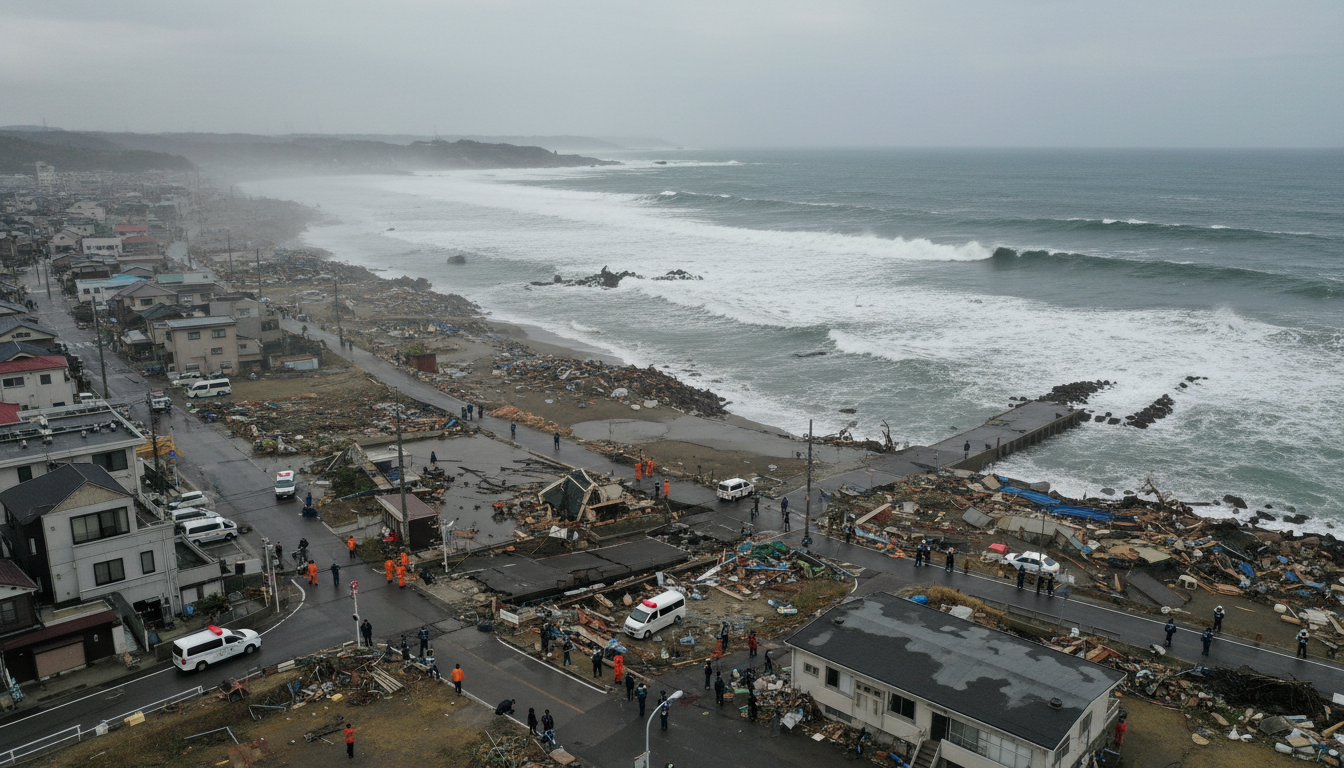
Sanriku offshore earthquake on April 20, 2026 shakes Aomori; tsunami of 80 cm observed in Iwate
Sanriku offshore earthquake on April 20, 2026 shook Aomori and prompted tsunami warnings from Hokkaido to Tohoku; JMA lifted alerts at 23:45 JST. Stay alert.
Sanriku offshore earthquake strikes in the evening
The Sanriku offshore earthquake struck in the evening of April 20, 2026, producing strong shaking across northern Honshu and coastal seas off the Sanriku coast. The Japan Meteorological Agency (JMA) reported an intensity of 5-plus on its seismic scale in parts of Aomori Prefecture. Coastal monitoring stations in Iwate Prefecture recorded a tsunami of approximately 80 centimeters following the quake. Residents along the affected coastlines were ordered to stay alert as warnings and advisories were issued.
The quake’s timing and offshore epicenter raised immediate concern for tsunami generation and secondary hazards. Local governments activated emergency response channels and advised people near the shore to move to higher ground. Transportation services in the region experienced delays as operators implemented safety checks. Utilities and infrastructure teams began rapid inspections for damage and continuity of essential services.
Aomori records strong shaking; Iwate measures tsunami run-up
Aomori Prefecture experienced some of the strongest shaking, with reports indicating furniture displacement and brief power interruptions in certain municipalities. The JMA intensity reading of 5-plus indicates potential for non-structural damage and danger to those near unsecured objects. In Iwate, coastal tide gauges recorded an 80-centimeter tsunami, prompting local shoreline evacuations and temporary closures of ports and fishing harbors. No immediate reports of large-scale coastal inundation were confirmed, but authorities cautioned that local effects vary with shoreline topology.
Harbor and coastal facility operators were ordered to suspend operations until inspections confirmed safety. Fishing crews and small craft were advised to remain in port and follow local harbor master instructions. Emergency shelters were readied in some towns as a precautionary measure. Local police and fire departments conducted swift patrols of vulnerable coastal zones to verify that residents had moved to safer elevations.
JMA issues and later lifts tsunami warnings and advisories
Following the earthquake, the Japan Meteorological Agency issued tsunami warnings and advisories covering areas from Hokkaido through the Tohoku region, reflecting the potential for wave activity along an extensive stretch of coastline. Those alerts remained active into the evening before the JMA announced full cancellation of tsunami warnings and advisories at 23:45 JST on April 20, 2026. The agency emphasized that while immediate tsunami risk had subsided, local sea-level changes and currents could persist for hours. Residents were advised to avoid entering the ocean and to heed local emergency bulletins.
The cancellation came after successive observations showed a tapering of wave heights and no evidence of additional tsunami generation. Nevertheless, the JMA and municipal authorities stressed that smaller-scale coastal surges, strong currents, and unpredictable waves can continue to affect shorelines. Fishermen and recreational users of coastal waters were specifically warned to refrain from returning to sea until explicit clearance was issued. Transportation operators were told to complete post-event safety inspections before resuming normal services.
Advisory on elevated trench rupture risk remains in effect
Separate from the immediate tsunami warnings, the JMA has been issuing a specialized advisory — referred to in Japanese as 北海道・三陸沖後発地震注意情報 — signaling that the likelihood of a large rupture along the Kuril and Japan Trenches is currently higher than usual. That advisory, covering the Kuril Trench and Japan Trench regions, calls for heightened vigilance and reinforces routine readiness measures. Authorities reminded residents that such advisories do not predict a specific event but indicate increased overall seismic potential in the trench zone. The message urged households, businesses, and local governments to verify evacuation plans and emergency supplies.
Seismologists say trench-zone advisories reflect longer-term stress conditions along subduction interfaces rather than immediate aftershock sequences alone. Local governments were asked to confirm their disaster response protocols and ensure shelters, evacuation routes, and communications systems are operational. The advisory also recommended that critical infrastructure operators conduct rapid safety checks and prepare contingency measures should a larger event occur. Public messaging stressed that preparedness and timely response remain the primary defenses against tsunami and seismic hazards.
Local governments and emergency services mobilize checks and shelters
Municipalities across Hokkaido and the Tohoku coast mobilized emergency operations centers to coordinate damage assessment, relief logistics, and public information. Evacuation centers were opened in coastal towns where citizens were urged to stay until authorities confirmed coastal safety. Emergency responders prioritized search and rescue readiness while utility crews performed inspections on bridges, roads, and lifeline systems. Local governments also set up hotlines and information pages to provide updates on shelter availability and transport disruptions.
Community volunteers and neighborhood disaster-management groups played a role in checking on elderly and vulnerable residents, assisting with short-term needs and transportation where required. Schools and workplaces in affected municipalities followed local directives regarding temporary closures or early dismissals. The central government indicated it was monitoring the situation and stood ready to deploy additional resources if requested by prefectural authorities. Clearances for returning to coastal areas will be issued only after thorough inspections and official announcements.
Guidance for residents: immediate steps and ongoing vigilance
Residents in coastal and nearby areas are advised to maintain situational awareness despite the lifting of tsunami alerts, as aftershocks and sea-level anomalies can continue for an extended period. Household checks should include verification of emergency kits, evacuation routes, and communication plans with family members. Individuals living in multi-story buildings or on higher ground are asked to offer assistance to neighbors who may need help reaching safe locations. Those who observed damage to structures or infrastructure should report conditions to local authorities rather than attempting extensive repairs themselves.
Authorities recommend avoiding beaches, river mouths, and ports until clearances are posted, and to follow official information channels for updates. Businesses and transport operators should document any operational impacts and coordinate with government agencies regarding resumption of services. Public information will continue to be disseminated through municipal platforms, radio, and other emergency communication systems. Preparedness remains the most effective step as monitoring continues in the days ahead.
Emergency services and meteorological agencies continue to monitor seismic activity and coastal conditions following the April 20, 2026 Sanriku offshore earthquake, and residents are urged to remain alert and follow local instructions.

