
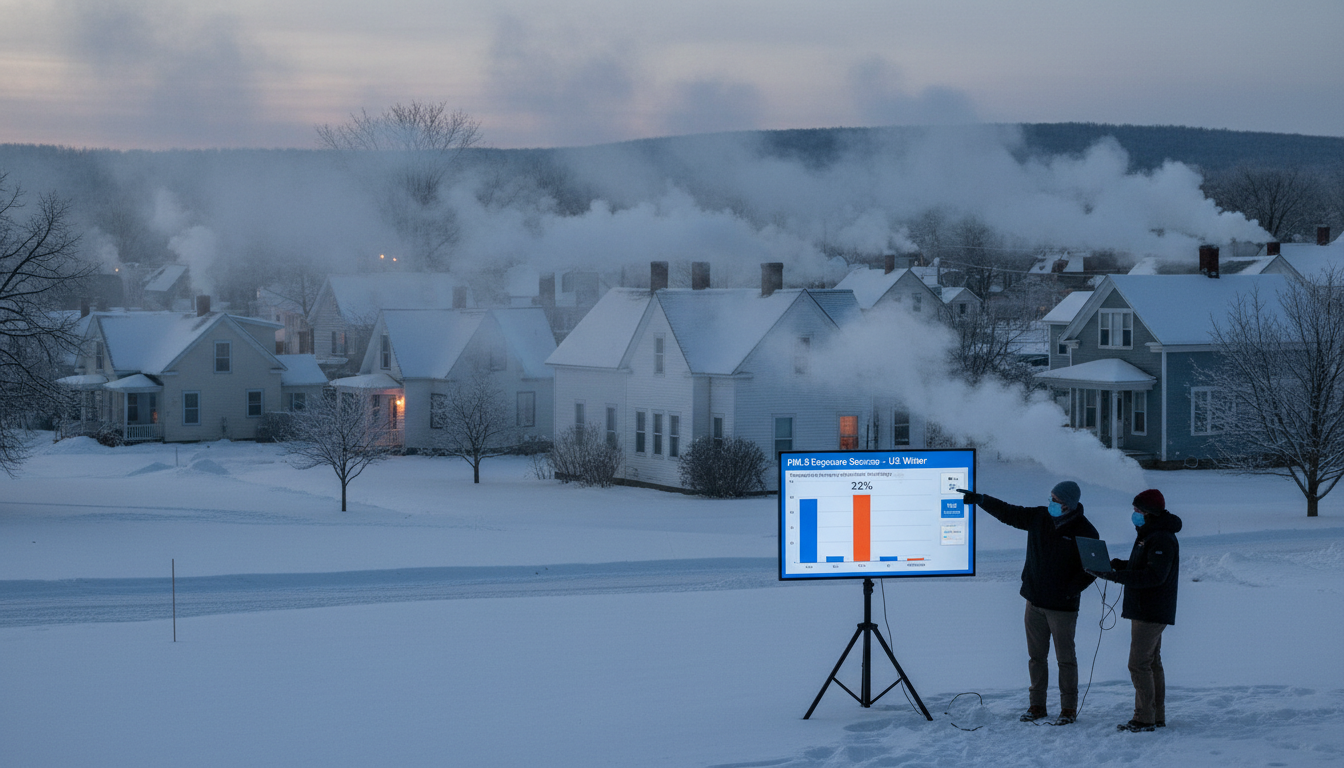
Northwestern study links residential wood burning to 22% of U.S. winter PM2.5
Northwestern researchers find residential wood burning accounts for roughly 22% of U.S. winter PM2.5 and is tied to an estimated 8,600 premature deaths annually.
Adding a log to a home fireplace may feel benign, but a new Northwestern University analysis shows residential wood burning significantly increases winter air pollution across the United States. The study finds that although just 2% of U.S. households rely on wood as a primary heating source, residential wood burning contributes about 22% of Americans’ winter exposure to outdoor fine particulate matter (PM2.5). Researchers estimate this pollution is associated with roughly 8,600 premature deaths each year, highlighting an outsized public health impact from a small fraction of homes.
Northwestern study links residential wood burning to 22% of winter PM2.5
The research, led by Northwestern undergraduate Kyan Shlipak and senior author Daniel Horton, was published on January 23 in Science Advances. The team combined emissions inventories with atmospheric simulations to isolate the contribution of residential wood combustion to seasonal PM2.5 concentrations. Their comparison of model runs with and without household wood emissions produced the 22% figure, making wood smoke one of the largest single sources of fine particle pollution during the coldest months.
The analysis used the U.S. Environmental Protection Agency’s National Emissions Inventory as its emissions baseline and applied a high-resolution atmospheric framework to estimate how particles disperse and transform. That methodology allowed the researchers to move beyond county-level averages and identify local hotspots where smoke accumulates and lingers. The study was funded in part by the National Science Foundation under award CAS-Climate-2239834.
High-resolution modeling maps neighborhood-level smoke
To reveal fine-grained exposure patterns, the team divided the continental United States into 4 km-by-4 km grid cells and ran hourly simulations of emissions and atmospheric chemistry. The model incorporated meteorology, terrain, and chemical reactions that convert primary emissions into secondary particles. By running paired scenarios with and without residential wood inputs, researchers could map where wood smoke most increases PM2.5 and when those increases peak during winter periods.
This neighborhood-level approach exposed pollution patterns that would be invisible in coarser inventories, including downwind accumulation in dense population centers. The modeling captured not just local emissions but transport processes that carry smoke from suburban and rural burning into cities. Those transport dynamics help explain why areas with relatively few wood-burning homes can still experience elevated PM2.5 during cold snaps.
Estimated health toll: about 8,600 premature deaths annually
Combining pollution increments with census tract mortality data, the authors translated exposure increases into an estimated mortality burden. The study’s central estimate links wintertime residential wood smoke to approximately 8,600 premature deaths each year from long-term PM2.5 exposure. That figure represents a substantial public health cost given the small share of households that burn wood as their primary heat source.
The researchers emphasize the estimate reflects outdoor exposure during winter and does not include indoor particulate exposures from household burning, which may add further risk. They also note the mortality estimate depends on established concentration–response relationships for PM2.5 and underlying baseline health statistics, making it a conservative indicator of overall harm from household wood combustion.
Urban centers and racial disparities drive unequal exposures
Contrary to common assumptions, the study finds urban and suburban communities bear a disproportionate share of wood-smoke-related harms. Smoke produced in suburbs and exurbs is frequently transported into densely populated city centers, increasing exposure where more people live. The result is larger health impacts in metropolitan areas, even when fewer city residents burn wood themselves.
The analysis also identifies stark racial disparities: people of color experience higher exposure and greater estimated health effects despite contributing comparatively less to wood-burning emissions. The authors attribute this pattern in part to higher baseline mortality rates and the lingering effects of discriminatory policies that increase vulnerability, meaning transported pollution imposes outsized burdens on historically marginalized communities.
Why home wood burning has been overlooked in policy
Public attention has focused heavily on wildfire smoke, motor vehicles, power plants, and industrial emissions, while routine residential wood burning has attracted less regulatory scrutiny. The study’s authors argue this lack of attention stems partly from the small fraction of homes that report wood as a primary heat source. That reporting pattern has led policymakers to underestimate how much wintertime PM2.5 originates from residential combustion across many regions.
Researchers suggest that because a limited number of homes are responsible for a large fraction of winter pollution, targeted interventions could yield rapid improvements. Measures such as appliance upgrades, fuel switching, or incentives to adopt cleaner heating technologies could reduce ambient PM2.5 more efficiently than many broader controls in the short term.
Cleaner heating alternatives could yield outsized benefits
The study points to viable pathways for reducing the health burden of wood smoke, including promoting noncombustion heating systems and cleaner-burning appliances where replacements are feasible. Officials could couple subsidies, information campaigns, and local ordinances to accelerate transitions away from solid-fuel heating in neighborhoods that generate the largest downwind impacts. Such policies would need to account for affordability and housing stock differences to avoid unintended burdens on low-income households.
The researchers emphasize that reducing residential wood burning would not only lower outdoor PM2.5 but also decrease indoor exposures for households that continue to burn, multiplying public health gains. They call for coordinated policy responses that prioritize the communities most affected by transported smoke and that invest in equitable access to cleaner heating options.
The Northwestern study reframes a familiar winter ritual as a public health challenge with clear pathways for mitigation, showing that modest behavioral and equipment shifts in a small share of homes could deliver measurable nationwide benefits.

