
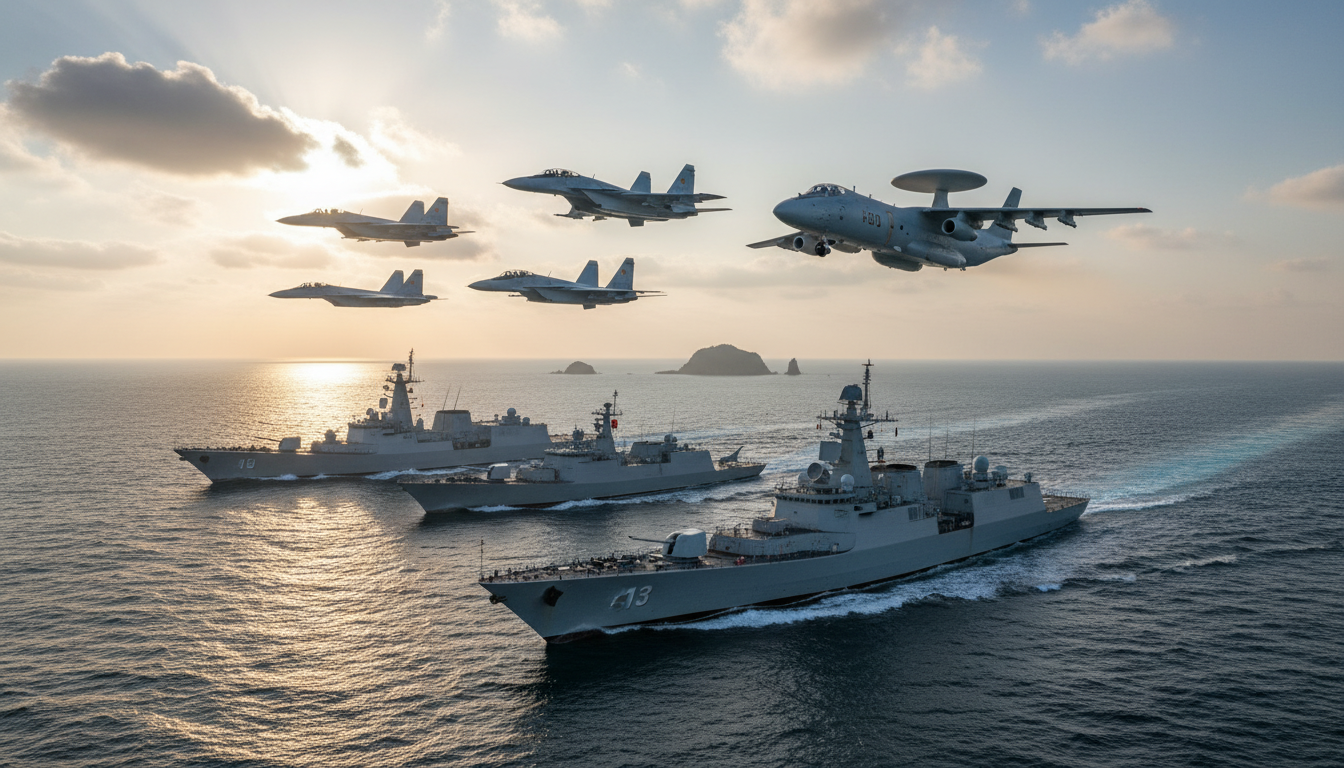
Chinese Military Conducts Joint Combat Readiness Patrols in the East China Sea
China’s military deployed naval and air forces for joint combat readiness patrols in the East China Sea, a move announced after a Japanese warship transited the Taiwan Strait.
Summary of the operation
The Chinese Eastern Theater Command said it carried out combined naval and air patrols in the waters and airspace of the East China Sea on Saturday, describing the activity as "joint combat readiness patrols."
The command framed the operation as a routine exercise planned under its annual training schedule and aimed at testing joint operational capabilities.
Statement from Eastern Theater Command
Senior Col. Xu Chenghua, a spokesperson for the Eastern Theater Command, issued a formal statement saying the patrols were organized to assess and improve coordination between sea and air units.
Xu added that such operations are conducted "based on the need of the security situation" and are intended to safeguard what the command described as state sovereignty and regional security.
Forces and operational scope
Public details provided by the command identified participation by both naval vessels and aircraft, conducting coordinated maneuvers across maritime and aerial domains in the East China Sea.
The exercises were described as testing joint operations capability, indicating integrated command-and-control, communication drills, and coordinated responses between surface and air assets.
Timing linked to Japan-Taiwan Strait transit
The patrols took place a day after a Japanese warship transited the Taiwan Strait, an event that the command mentioned in its account of the sequence of activities.
While the Eastern Theater Command did not frame the patrols explicitly as a reaction, the timing drew attention from regional security observers as part of a pattern of military activity near contested waterways.
Tokyo response and diplomatic context
Japanese government officials had not issued an immediate detailed public statement on the patrols at the time of the announcement, consistent with the often measured diplomatic exchanges that follow such movements.
Tokyo has in recent years maintained that routine transits through international waters, including the Taiwan Strait, are lawful, while also expressing concern when military activity in nearby seas escalates.
Regional security trends and implications
Analysts note the East China Sea and the Taiwan Strait have become recurring focal points for military patrols, demonstrating a sustained emphasis on readiness by multiple regional actors.
These operations underscore a broader trend of overlapping patrols, increased training tempo, and heightened maritime presence that complicate risk management and crisis prevention in the area.
Impact on maritime and airspace safety
Combined naval and air patrols increase the density of military traffic in contested corridors and raise the need for clear communication channels to prevent misunderstandings.
Maritime and aviation authorities and navies typically monitor such exercises closely to manage safety and avoid accidental encounters between military and civilian vessels or aircraft.
Outlook and potential next steps
The Eastern Theater Command said it will continue to "routinely organize relevant military operations based on the need of the security situation," signaling further training activities may occur as strategic conditions evolve.
Observers in Tokyo, Taipei and allied capitals are likely to keep tracking patrol patterns and public statements to gauge whether the tempo of operations will shift or stabilize in the coming weeks.
The East China Sea episode highlights how tightly connected military signaling, routine transits and regional diplomacy have become, and it reinforces the need for consistent communication to reduce the risk of escalation.

