
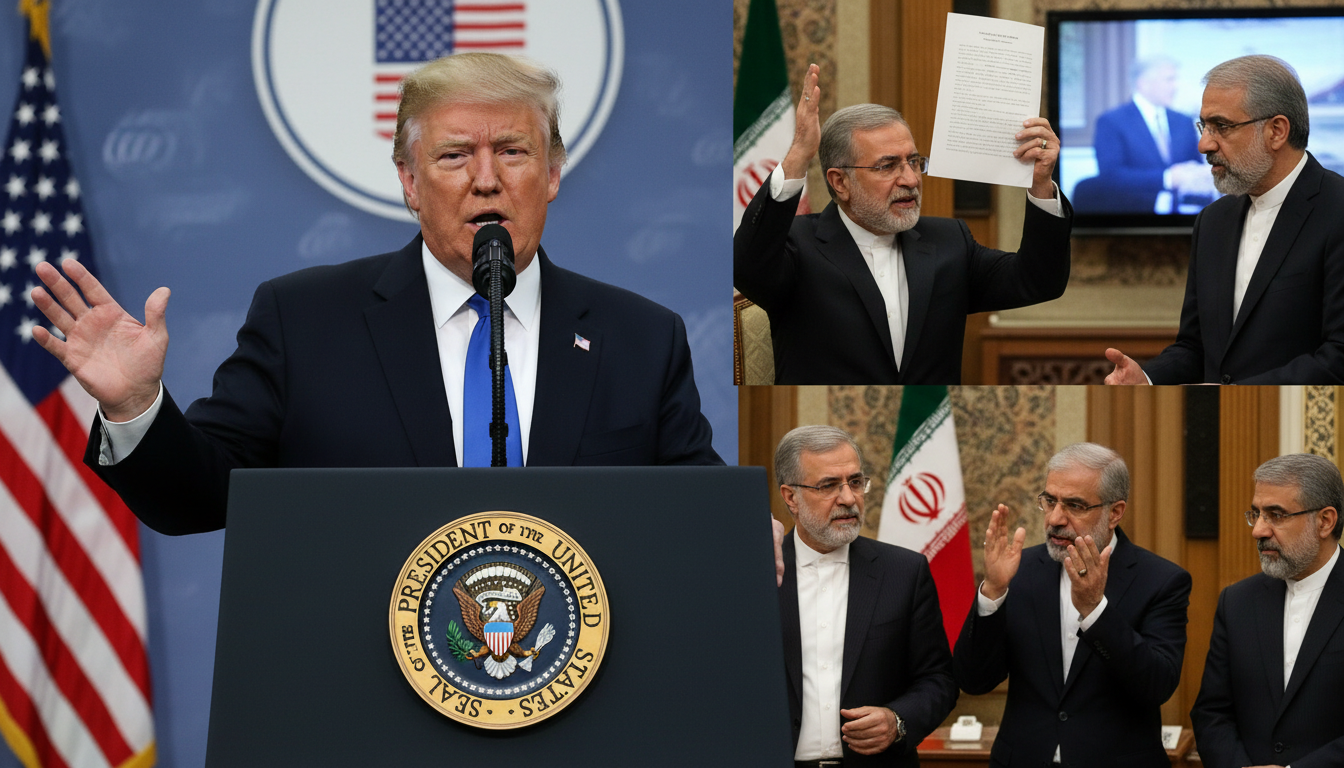
Trump claims Iran concessions provoke anger and confusion in Tehran
Trump claims Iran concessions triggered denials from Tehran, state media backlash, armed rallies and sharp market moves after the April 8 ceasefire talks.
The United States president’s public statements that Tehran agreed to hand over buried enriched uranium and cease domestic enrichment have generated swift denials and alarm from Iran’s political and military establishments. Trump claims Iran concessions were central to his announcements, which also referenced the reopening of the Strait of Hormuz and the removal of sea mines. Iranian authorities, hardline media and influential officials pushed back within hours, setting off a volatile mix of political recriminations, street demonstrations and market fluctuations.
U.S. announcements and the substance of the claims
Trump asserted that U.S. forces would cooperate with Iran to recover enriched uranium reportedly left under the rubble of damaged nuclear sites and that Tehran had agreed to stop enrichment on its soil. He also said the Strait of Hormuz had been reopened and would remain open, adding that sea mines were being cleared and that frozen Iranian assets abroad would not be returned due to sanctions. These sweeping claims were made as a two week ceasefire signed on April 8 approached its end and while Pakistan continued shuttle diplomacy aimed at broader negotiations.
Top Iranian officials and parliament speaker reject the narrative
Iran’s Parliament Speaker Mohammad Bagher Ghalibaf, who led the recent delegation to Islamabad, publicly dismissed the U.S. assertions and accused Washington of falsehoods. Senior figures and former officials branded the claims dishonest and warned against conceding strategic assets in negotiations. The pushback from Tehran’s political leadership underscored a deep distrust of U.S. statements and signalled that any reported concessions would face heavy scrutiny at home.
IRGC response and renewed restrictions on the Strait
The Khatam al Anbiya Central Headquarters of the Islamic Revolutionary Guard Corps said the Strait of Hormuz was again subject to heavy restrictions under the armed forces’ strict management. The statement linked renewed controls to what it called ongoing U.S. maritime actions amounting to piracy and theft under the guise of a blockade. The IRGC announcement followed the initial U.S. declaration about open shipping lanes and contributed to immediate confusion over maritime access and security.
State media backlash and criticism of the foreign minister
State-aligned broadcasters and IRGC-affiliated outlets sharply criticised Foreign Minister Abbas Araghchi after he tweeted that the Strait was open for the remaining ceasefire period on the coordinated route announced by ports authorities. TV hosts and analysts accused the foreign minister of poor timing and of communicating primarily in English at a time when most Iranians lack reliable internet access. Fars and Tasnim news agencies amplified the criticism, with commentators saying the message plunged parts of society into confusion and demanding immediate clarification.
Public reaction and mobilisation of government backers
Social media platforms and local messaging apps filled with angry responses from citizens and government supporters who said any surrender of uranium or maritime control would betray sacrifices made under years of sanctions. State outlets broadcast footage of armed convoys through Tehran waving flags of allied groups from Lebanon and Iraq as a show of strength. Officials appear to be encouraging visible street mobilisation by progovernment forces to reaffirm control while the political debate plays out behind closed doors.
Economic reverberations and currency volatility
Markets reacted quickly to the conflicting claims and responses, with oil prices dipping in late trading and the rial swinging sharply against the dollar. The currency moved from roughly 1.46 million rials per dollar to about 1.51 million after the IRGC announced renewed controls over the strait. Analysts say shortened trading windows and the information vacuum created by the continuing internet shutdown have amplified market sensitivity to political statements and military signalling.
Diplomatic actors continue to press for mediated talks even as domestic turmoil intensifies across Iran. Pakistan has been engaged in efforts to bring the parties together for further negotiation, but Tehran’s public denials and the IRGC’s firm stance complicate any immediate breakthrough. Calls by hardline commentators for a definitive statement from the supreme leadership added pressure on officials to present a united front before further diplomacy can proceed.
The rapid exchange between Washington and Tehran has highlighted deep fissures within Iran’s own political coalition and underscored how high level statements can trigger cascading effects on security, media narratives and the economy. Continued uncertainty over the Strait of Hormuz and the future of enrichment activity will likely keep regional tensions and market volatility elevated in the short term.

