
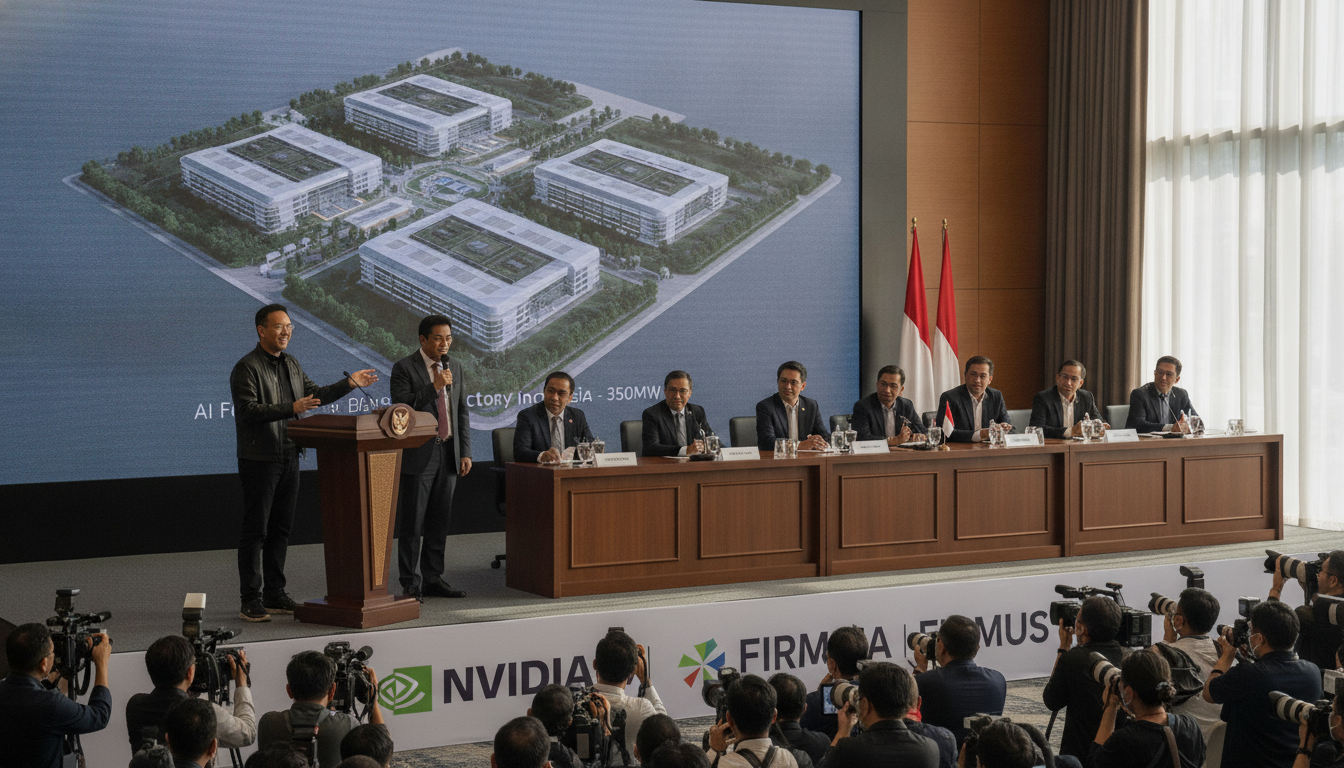
Firmus to build 350MW Nvidia-powered AI factory in Indonesia
Australian data centre builder Firmus will construct a 350MW Nvidia-powered AI factory in Indonesia to deliver cloud computing services to AI-native customers, the company said on June 29, 2026.
Firmus said on Monday that it will deploy Nvidia chips in the new Indonesian data centre and market Nvidia-powered cloud services to companies building artificial intelligence applications.
Project scale and scope
Firmus described the development as a 350-megawatt "AI factory," a designation signalling a facility optimised for large-scale AI model training and inference rather than traditional enterprise hosting.
A 350MW footprint places the project among the larger hyperscale builds in the region, implying extensive server halls, high-density racks and substantial cooling and network infrastructure. Firmus has not disclosed the exact site location or the phased timetable for construction in its initial announcement.
Technology partnership with Nvidia
The company said it will base the facility’s compute layer on Nvidia chips, enabling customers to access GPU-accelerated cloud services tailored for machine learning workloads. Nvidia’s accelerators have become a standard for major AI workloads, and Firmus’ move signals a direct supply chain alignment with the chipmaker’s ecosystem.
By selling Nvidia-powered cloud services, Firmus intends to offer managed platforms that combine raw compute with software stacks optimised for model training and AI deployment. The partnership suggests Firmus will position the data centre to support customers that require ready-to-run GPU clusters rather than bespoke on-premise installations.
Target customers and service offerings
Firmus explicitly targeted "AI-native" customers, a category that includes startups, research institutions and enterprises whose core products depend on large-scale machine learning. The company plans to offer cloud instances configured for training large neural networks, as well as inference and data-processing capacity for production applications.
Services from the AI factory are likely to be packaged for both short-term burst capacity and longer-term reserved instances to meet fluctuating demand. Firmus said it will market these offerings in Indonesia and to regional clients seeking localised, low-latency AI compute close to Southeast Asian data sources.
Energy, infrastructure and permitting implications
Operating a 350MW AI facility will require sustained access to high-capacity power, robust fibre connectivity and advanced cooling systems to manage heat from dense GPU clusters. Securing power and grid capacity is typically a major permitting and commercial negotiation for projects of this scale.
Firmus has not yet published details on power sourcing, renewable integration or the cooling technologies it will deploy, but the scale of the build means energy procurement, environmental permits and local infrastructure upgrades will be central to project timelines. Local authorities and grid operators will play a key role in determining delivery schedules and operational readiness.
Regional market context and competition
Southeast Asia is witnessing a rapid uplift in demand for GPU-backed cloud compute as firms adopt AI-driven products and services, creating opportunities for regional data centre capacity. Firmus’ announcement places it in direct competition with global cloud providers and local operators racing to capture AI workloads close to data generation points.
By offering Nvidia-powered services from an Indonesian facility, Firmus aims to capitalise on both cost and latency advantages for regional customers while addressing data residency concerns. The move may accelerate other operators’ plans for GPU-dense facilities in the region as demand for AI compute grows.
Firmus’ plan to build the AI factory with Nvidia chips reflects a broader industry trend where data centre operators link closely with accelerator vendors to provide turnkey AI platforms. The company will now face the commercial and logistical challenge of turning a high-capacity proposal into an operational hub that meets both customer performance expectations and regulatory requirements.

