
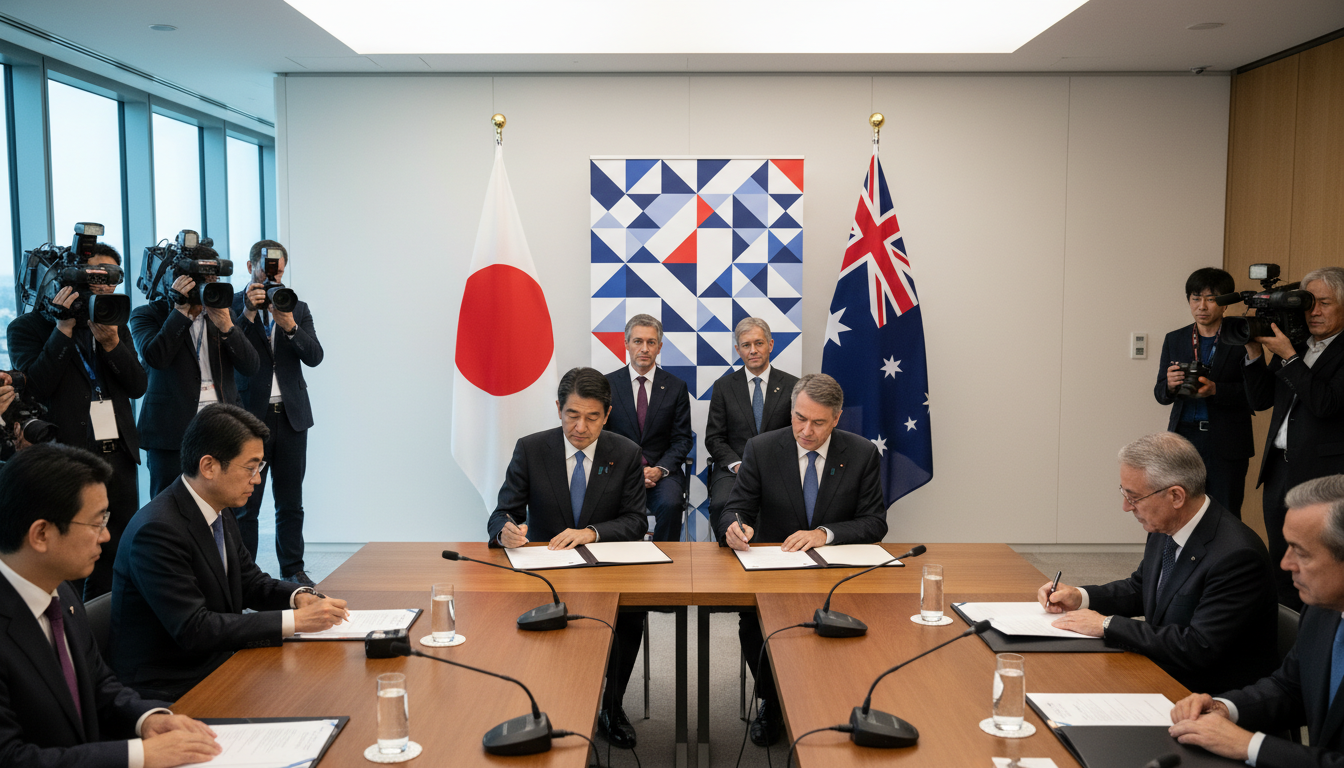
Japan and Australia sign joint declaration to bolster Japan-Australia economic security cooperation
Japan and Australia sign joint declaration in Canberra on May 4, 2026 to deepen economic security cooperation on energy, rare earths and critical supply chains.
Japan and Australia on May 4, 2026 signed a joint declaration in Canberra to deepen Japan-Australia economic security cooperation, focusing on energy and critical minerals including rare earths. The agreement, described by leaders as a strategic guide for closer economic-security ties, was endorsed at a meeting between Prime Minister Sanae Takaichi and Australian Prime Minister Anthony Albanese. The leaders said the declaration advances efforts to shore up supply chains that underpin industry and national resilience.
Takaichi and Albanese sign joint declaration
The signing in Canberra formalizes a shared commitment to strengthen supply-chain resilience across strategic sectors, with an emphasis on energy and important minerals. Prime Minister Takaichi framed the pact as part of a broader push to institutionalize comprehensive security cooperation between the two countries. Both leaders agreed the declaration would serve as a “strategic guidance” document to coordinate actions by ministers and agencies ahead of the next leaders’ meeting.
Scope of cooperation: energy and critical minerals
The joint declaration names energy supplies and critical minerals — notably rare earths — as priority areas for cooperation to reduce vulnerability to sudden disruptions. It calls for measures to diversify supply sources, enhance stockpiling and coordinate trade and investment policies that support secure access to materials essential for high-tech manufacturing and clean-energy transitions. Officials said the declaration also contemplates joint research, industrial partnerships and private-sector engagement to strengthen resilient value chains.
Security drivers cited by leaders
Leaders cited recent geopolitical developments as immediate drivers for the pact, noting concerns that disruptions in the Middle East and trade pressures in the region could unsettle global energy and mineral flows. The two governments explicitly expressed “strong concern” about export restrictions that could impede supply security, signaling unease over unilateral measures that affect access to critical inputs. The declaration frames economic security as integral to national defense and economic stability, linking commercial policy with strategic planning.
Institutionalizing cooperation and next steps
Takaichi and Albanese directed cabinet ministers and relevant agencies to translate the declaration into concrete institutional arrangements before the next summit between the two countries. That work is expected to include the creation of joint task forces, regular ministerial dialogues and mechanisms for rapid information sharing during supply shocks. Officials will reportedly tabulate priority commodities, assess vulnerabilities and propose concrete tools — from procurement coordination to cooperative stockpiles — to operationalize the strategic guidance.
Regional and economic implications
Analysts say the pact could accelerate Australia’s role as a supplier of energy and critical minerals to Japan, while giving Japanese industry clearer assurances about long-term access to materials needed for electric vehicles, batteries and defense-related technologies. Strengthening supply chains between Tokyo and Canberra may also encourage allied cooperation on standards and investment screening to guard sensitive technologies. The move comes as other partners in the region and beyond reassess dependencies and seek diversified sourcing to reduce strategic exposure.
Japan-Australia economic security cooperation under this declaration is likely to draw attention from industry groups and trading partners, who will watch for new procurement rules, joint ventures and infrastructure projects. Business leaders may be invited into consultations to ensure practical measures align with market realities, while governments weigh how to balance open investment with protections for strategic assets. The declaration stops short of binding procurement mandates but signals a stronger political will to use policy tools in support of secure supply networks.
The leaders framed the pact as an enhancement, not a replacement, of existing bilateral ties, saying it complements defense and diplomatic cooperation by adding an economic-security dimension. Both governments emphasized that the initiative aims to preserve open trade while reducing the risk of coercive disruptions, pointing to cooperation rather than confrontation as the guiding principle. Observers noted that swift ministerial follow-up will be essential to convert the declaration’s ambitions into tangible outcomes for industry and national security.
The joint declaration signed in Canberra on May 4, 2026 marks a notable step in Japan-Australia economic security cooperation, setting a timetable for ministers to draft institutional arrangements ahead of the next leaders’ visit. Officials on both sides say they will report progress publicly as working groups complete assessments and propose specific policy measures. The coming months will reveal whether the declaration produces new supply agreements, shared stockpiles or coordinated industrial strategies to bolster resilience against future shocks.

