
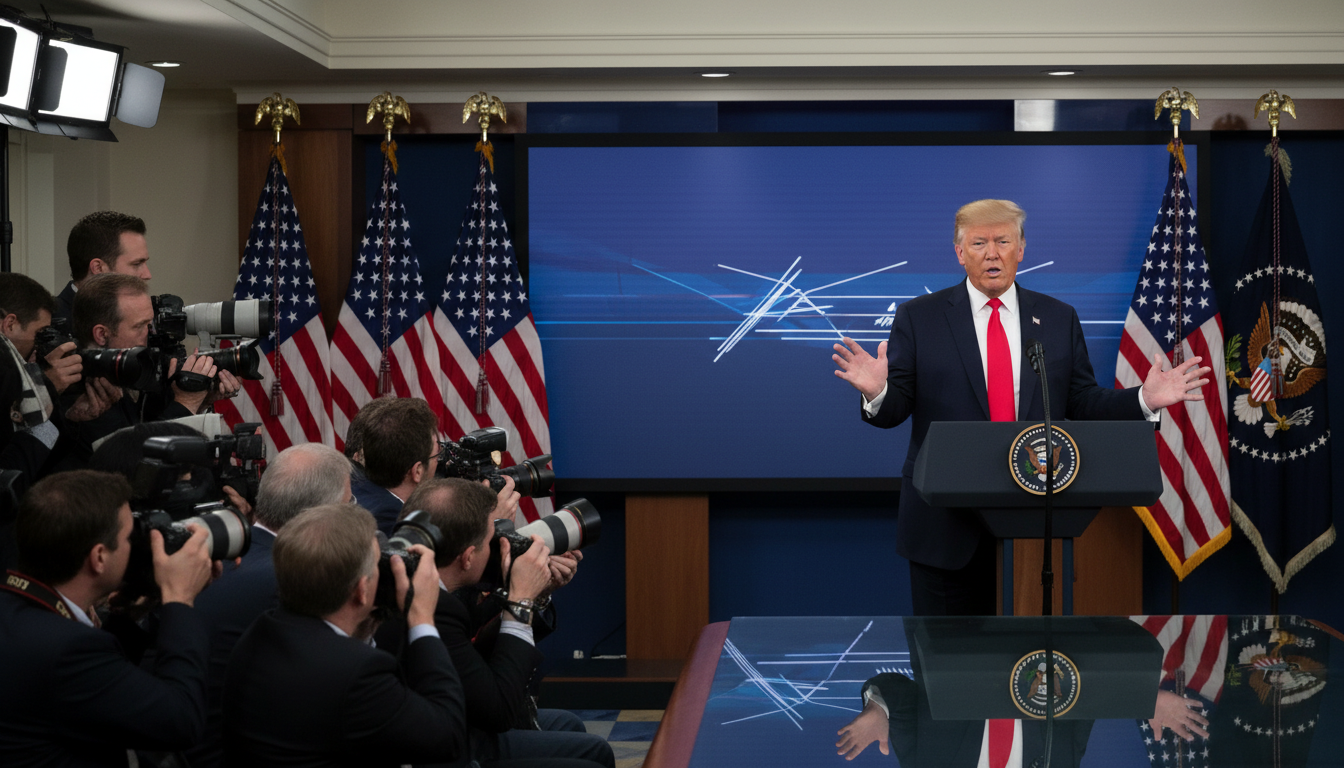
Trump says new Iran nuclear deal will be “far better” as ceasefire extended and talks planned
Trump says a new Iran nuclear deal will be far better than the 2015 JCPOA, as a ceasefire is extended and talks in Islamabad focus on halting uranium enrichment.
President’s claim and ceasefire extension
President Donald Trump has asserted that a forthcoming Iran nuclear deal under negotiation would be “far better” than the 2015 Joint Comprehensive Plan of Action. He extended a two‑week ceasefire with Iran one day before it was due to expire, signaling hopes for continued diplomacy and a second round of talks in Islamabad.
The announcement frames enrichment restrictions as a central U.S. demand and comes amid sustained international concern about Tehran’s elevated enrichment activities. Officials on both sides are reported to be negotiating terms, with the halt or reduction of uranium enrichment at the center of the dispute.
U.S. demand to stop enrichment and Iran’s response
A leading U.S. demand in the current talks is that Iran cease all uranium enrichment, a red line Washington says is necessary to prevent a military nuclear capability. Iran has repeatedly maintained its program is for civilian purposes such as electricity generation and medical isotopes, arguing that low levels of enrichment are permitted under international agreements.
Diplomats say the two sides are discussing technical compromises, including Iran’s suggestion to “downblend” higher‑enriched stocks to a lower concentration. Negotiators must bridge technical, legal and political gaps if a revised Iran nuclear deal is to gain traction.
From ore to reactor fuel: how uranium is processed
Uranium begins as a mined metal found in rocks, soil and seawater and is converted into several industrial forms before it can fuel reactors. Mined ore is refined into a concentrated powder known as yellowcake, which is then chemically transformed into uranium tetrafluoride and ultimately uranium hexafluoride (UF6) for enrichment.
After enrichment, UF6 is converted to uranium dioxide, pressed into ceramic pellets and assembled into fuel rods for reactors. Each stage requires specialized facilities, equipment and safeguards to monitor material flows and prevent diversion.
Enrichment mechanics: centrifuges and isotopes
Natural uranium contains mostly U‑238 and a small fraction of U‑235, the isotope capable of sustaining a chain reaction. Enrichment separates the lighter U‑235 from U‑238 by transforming uranium into a gas and spinning it in high‑speed centrifuges, where centrifugal force concentrates isotopes by mass.
Individual centrifuges provide only modest separation and are arranged in cascades to reach higher concentrations. The complexity and scale of a cascade, together with monitoring by international inspectors, determine how quickly a state can raise enrichment levels.
Levels of enrichment and the work required
Enrichment levels are categorized by percentage of U‑235: commercial reactor fuel is typically 3–5 percent, research reactors use up to about 20 percent, and weapons‑grade material is generally about 90 percent. The International Atomic Energy Agency treats below 20 percent as low‑enriched uranium and above that as highly enriched uranium.
The effort to reach a given enrichment is measured in separative work units (SWU) and is non‑linear; going from natural uranium to 20 percent demands far more work than progressing from 60 percent to 90 percent. Analysts estimate that once a stockpile reaches roughly 60 percent enrichment, completing the final steps to weapons‑grade material can take weeks rather than years.
Iran’s stockpiles, centrifuge capacity and concealment risks
International monitors have reported Iran holds enriched uranium stocks at several enrichment levels, including material enriched to around 60 percent U‑235. Estimates indicate several hundred kilograms at that concentration, quantities that, if further enriched, could theoretically be converted into weapons‑usable material in a short period.
Iran has invested in advanced centrifuge models as well as large numbers of older machines, and some facilities are situated deep underground, complicating the prospect of a decisive military strike. Experts warn that small, covert centrifuge cascades can be installed in limited spaces and powered by modest electrical sources, creating a risk of clandestine acceleration of enrichment.
Treaties, past agreements and the path forward
Iran is a signatory to the Treaty on the Non‑Proliferation of Nuclear Weapons, which recognizes the right to peaceful nuclear technology under safeguards but aims to prevent weaponization. The 2015 JCPOA curtailed Iran’s enrichment and introduced intrusive inspections in exchange for sanctions relief until the United States withdrew in 2018.
Attempts to revive the 2015 framework have stalled at various points, with disputes over sequencing of sanctions relief and compliance. Iranian officials have signaled willingness to downblend some high‑enriched stocks as a confidence‑building measure, while the United States has emphasized a complete halt to enrichment as a core condition of any new agreement.
As talks proceed in Islamabad, negotiators face technical trade‑offs and political constraints on both sides, and the durability of any Iran nuclear deal will depend on verifiable limits, inspection mechanisms and clear timelines for implementation. The coming weeks will be critical in determining whether diplomacy can translate into durable limits on enrichment and a reduction of regional tensions.

