
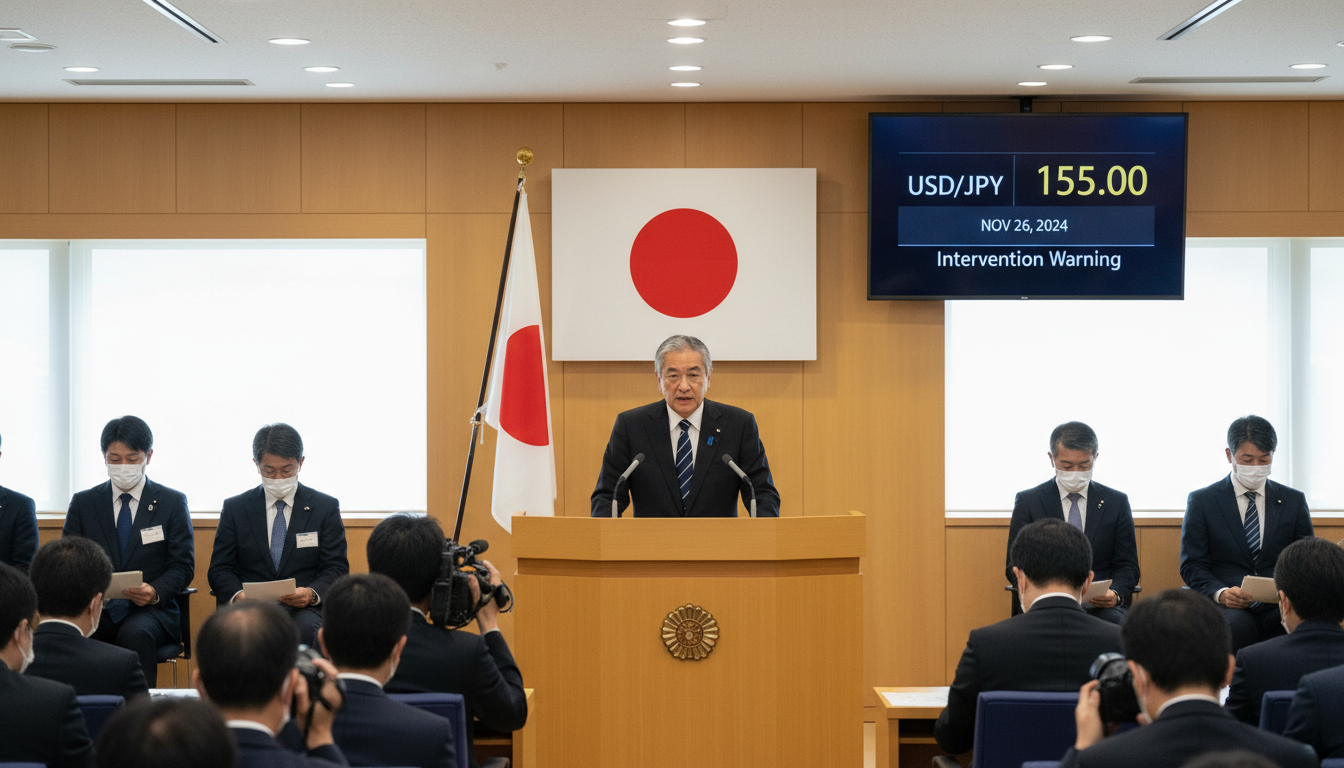
Yen surges over five yen to mid-155s after Katayama’s warning, markets brace for possible intervention
Japan’s yen jumped sharply to the mid-155 per dollar range on April 30 after Finance Minister Satsuki Katayama warned that the timing for “decisive measures” was approaching, prompting heavy yen buying amid intervention fears. The sudden move represented a gain of more than five yen from earlier in the day and came as traders parsed the minister’s language for signs of imminent government action. (bloomberg.com)
Sharp intraday reversal in USD/JPY
The dollar-yen rate fell from the day’s earlier weakness to trade in the mid-155s, with major market screens registering levels around 155.5–155.8 at the peak of the reversal. The abrupt change in direction followed the public remarks by senior finance officials and led to a spike in trading activity in yen pairs. (bloomberg.com)
Earlier in the Tokyo and London sessions the dollar had been significantly stronger, pushing the pair into the 160-yen area before the late reversal. Traders described the price action as rapid and headline-driven, with momentum quickly shifting as market participants reassessed the balance of risk between further yen weakness and the prospect of policy intervention. (newsdig.tbs.co.jp)
Katayama’s ‘decisive measures’ comment and timing
Finance Minister Satsuki Katayama told reporters that “the timing for the decisive measures I have long referenced is approaching,” language that market participants widely interpreted as a strong signal that authorities were prepared to act if the yen’s slide continued. Her remarks were delivered during an afternoon briefing and reverberated across trading desks. (bloomberg.com)
The finance ministry’s choice of words — echoing earlier statements by other senior officials — is treated in Tokyo as a calibrated warning intended to deter speculative flows without formally announcing a specific operation. Still, traders said the phrasing was sufficient to ratchet up expectations of coordinated action between the government and the Bank of Japan. (nippon.com)
Market reaction and intervention expectations
Following the minister’s remarks, market participants accelerated yen buying and dollar selling amid heightened caution that authorities could step in to blunt further depreciation. Dealers noted that the shift was driven as much by positioning and risk-management trades as by outright speculative unwinding. (newsdig.tbs.co.jp)
Observers pointed to the speed of the move as evidence that verbal intervention — public warnings intended to influence market psychology — remains a potent tool, and that the mere suggestion of direct intervention can trigger large-scale flows in the thin periods of the trading day. Several foreign-exchange desks reported order books thinning as traders pulled back, amplifying price moves. (bloomberg.com)
Trading dynamics and liquidity conditions
Traders said liquidity conditions were uneven as the reversal unfolded, with offshore and late-session trading amplifying volatility. That dynamic allowed concentrated yen-buying orders to have an outsized effect on the USD/JPY rate in a short window. (bloomberg.com)
Market participants also highlighted that headline-driven episodes often attract algorithmic and momentum-driven flows, which can deepen intraday swings when human liquidity providers step to the sidelines. Several institutional traders indicated they were monitoring bid-ask spreads and execution quality closely in the aftermath. (newsdig.tbs.co.jp)
Policy backdrop and recent precedent
The government’s recent public language on exchange-rate risk has been increasingly firm, with officials in recent weeks warning against “excessive” and “disorderly” moves and explicitly referencing a readiness to act. Analysts say the remarks form part of a sequence intended to deter further yen weakness without immediately resorting to a full-scale, disclosed intervention. (newsweekjapan.jp)
Market analysts note that Tokyo’s playbook combines verbal deterrence, behind‑the‑scenes communications with major counterparties and, at times, direct spot market operations coordinated with the Bank of Japan and foreign authorities. The effectiveness of any measure depends on timing, scale and international backing, according to commentators familiar with past episodes. (nippon.com)
Implications for investors and near‑term outlook
The episode underscores how sensitive the yen remains to both domestic policy signals and global risk drivers, including interest-rate differentials and commodity price swings. Asset managers and corporate treasuries said they were reassessing hedging strategies in response to the renewed volatility. (bloomberg.com)
Looking ahead, market watchers said the immediate direction of USD/JPY will hinge on follow-up comments from the finance ministry, any visible coordination with the Bank of Japan, and risk sentiment in overseas markets. Absent new guidance, traders expect continued headline-driven spikes and rapid position adjustments as participants price the odds of official intervention. (newsdig.tbs.co.jp)
The sudden yen rally on April 30 serves as a reminder that Japanese authorities retain a range of tools to influence the currency, and that carefully chosen public statements can produce swift market reactions. Investors and companies with yen exposures will likely watch official communications closely in the coming days for clearer signals on whether Tokyo intends to move beyond verbal warnings to direct market operations. (bloomberg.com)

