
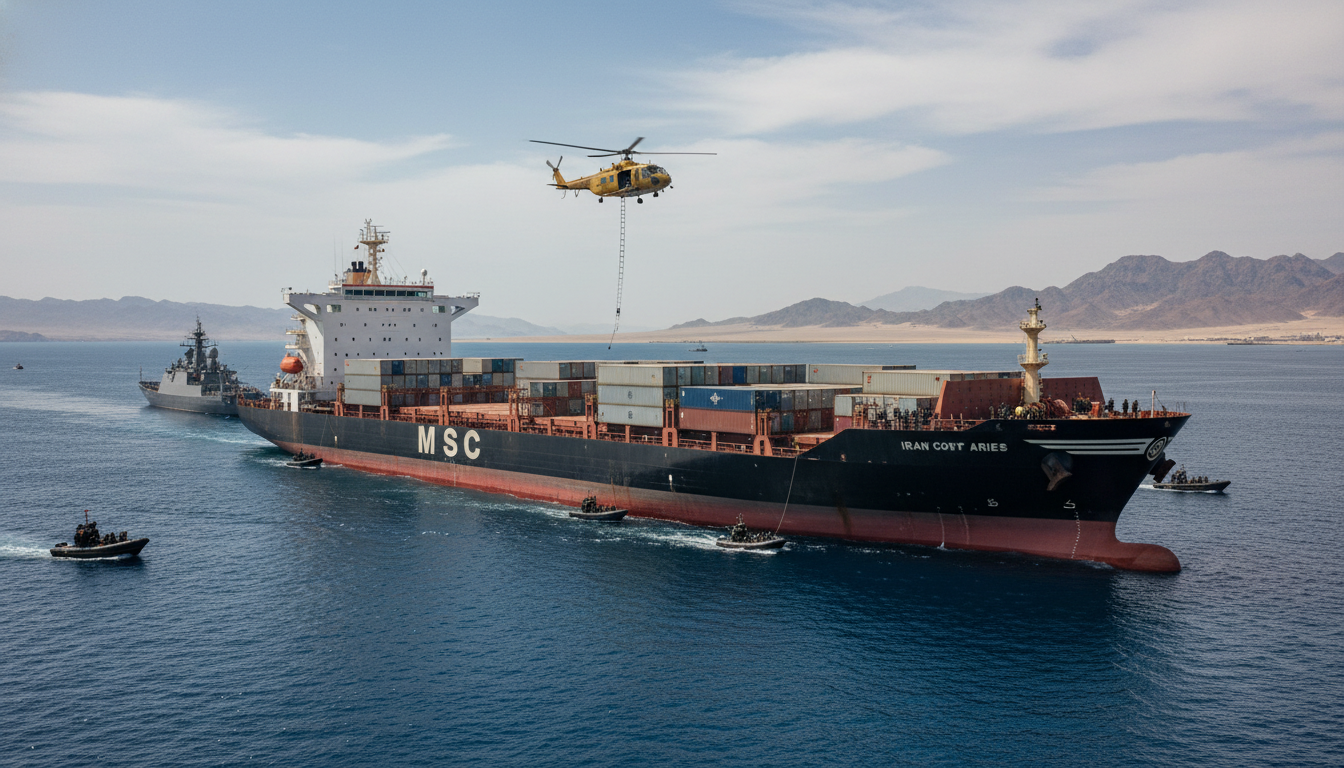
Iran’s Revolutionary Guard Releases Video Showing Strait of Hormuz Ship Seizure
Iran’s Islamic Revolutionary Guard Corps released footage it says shows its forces seizing a container ship in the Strait of Hormuz, one of two vessels taken on Wednesday, April 23, 2026.
Iran’s Islamic Revolutionary Guard Corps (IRGC) released a video it says documents the boarding and seizure of a container ship in the Strait of Hormuz, the military said on 23 April 2026. The seized vessel was described by Iranian authorities as one of two container ships taken in the waterway on Wednesday, according to the footage and official statements.
IRGC Publishes Footage of Boarding Operation
The video released by the IRGC purports to show multiple small boats approaching and personnel boarding the container ship in the narrow international waterway. Visuals in the footage include armed uniformed personnel on deck and scenes of crew interaction, which Iranian state outlets have used to substantiate the claim.
Iranian officials framed the action as an enforcement operation, but independent verification of the sequence and the full circumstances in the footage was not available at the time of release. International maritime observers and shipping companies typically seek further information before confirming such claims.
One of Two Container Ships Seized on Wednesday
Authorities in Iran said the container ship shown in the video was one of two vessels taken on Wednesday, but they did not immediately publish identifying details about the ships’ names, flags or the nationalities of crew members. That limited public information has left key questions about ownership, cargo and the condition of the crew unanswered.
Shipping registries, owners and insurers often take time to confirm incidents, and industry sources may withhold details pending crew contact and safety checks. The lack of immediate independent statements from ship operators or classification societies made it difficult to corroborate the IRGC’s account within hours of the video’s release.
Strait of Hormuz Remains a Critical Maritime Chokepoint
The Strait of Hormuz is one of the world’s busiest and most strategically sensitive maritime chokepoints, serving as a transit point for large volumes of oil, liquefied natural gas and containerized cargo. Any seizure or disruption in the strait tends to attract swift attention from governments, shipping firms and insurers because of the potential impact on global trade flows.
Commercial vessels transiting the waterway are subject to heightened security protocols and may alter routing or schedules in response to perceived risks. The geography of the strait—with narrow corridors and heavy tanker traffic—means incidents there have outsized economic and diplomatic consequences.
Potential Impact on Shipping, Routes and Insurance
A confirmed seizure in the Strait of Hormuz can prompt short-term disruptions to shipping schedules and raise voyage-risk premiums for affected routes. Vessel operators commonly review transit plans, seek advice from security consultants and consider alternative passages when feasible to mitigate exposure.
Insurers and protection-and-indemnity clubs monitor such developments closely because escalations can lead to increases in war-risk and kidnap-and-ransom cover premiums. Port call schedules and liner services may be adjusted to limit vulnerability, and some shippers may elect to delay sailings until clarity on safety and legal status is established.
Diplomatic and Verification Challenges After the Video Release
Incidents in the strait typically lead to diplomatic outreach and calls for independent verification, and the IRGC’s video release is likely to trigger similar responses. As of 23 April 2026, no independent verification from international maritime organizations or shipowners had been publicly confirmed, underscoring the need for follow-up reporting and official confirmations.
Foreign ministries, consular services and shipping registries generally seek to establish the welfare of seafarers and clarify legal grounds for seizures under international law. Such inquiries can involve multiple states and agencies, adding a diplomatic dimension to what initially appears as a security or enforcement action at sea.
What Shipping Operators and Coastal States Are Watching Next
Shipping companies and coastal states will be watching for official ship registry records, statements from owners or managers, and reports from international maritime bodies for confirmation and details. Crew safety, cargo manifests and port disembarkation plans are among the immediate priorities for stakeholders attempting to assess operational and humanitarian implications.
Analysts will also monitor whether the action prompts changes in naval patrols, convoy escorts or multinational coordination measures in and around the Gulf. The responses of regional powers and of maritime insurance markets will be key indicators of whether the incident remains localized or escalates into a broader disruption.
Recordings and state-released visuals such as the IRGC video are often the first public evidence in maritime incidents, but they rarely close the information gap alone. Independent verification, official vessel documentation and statements from ship operators are typically required to assemble a complete picture.
The situation around the Strait of Hormuz remains fluid; authorities, shipowners and international maritime bodies are likely to provide updates as they confirm details about the two container ships, the condition of their crews and the legal basis cited for the seizures.

