
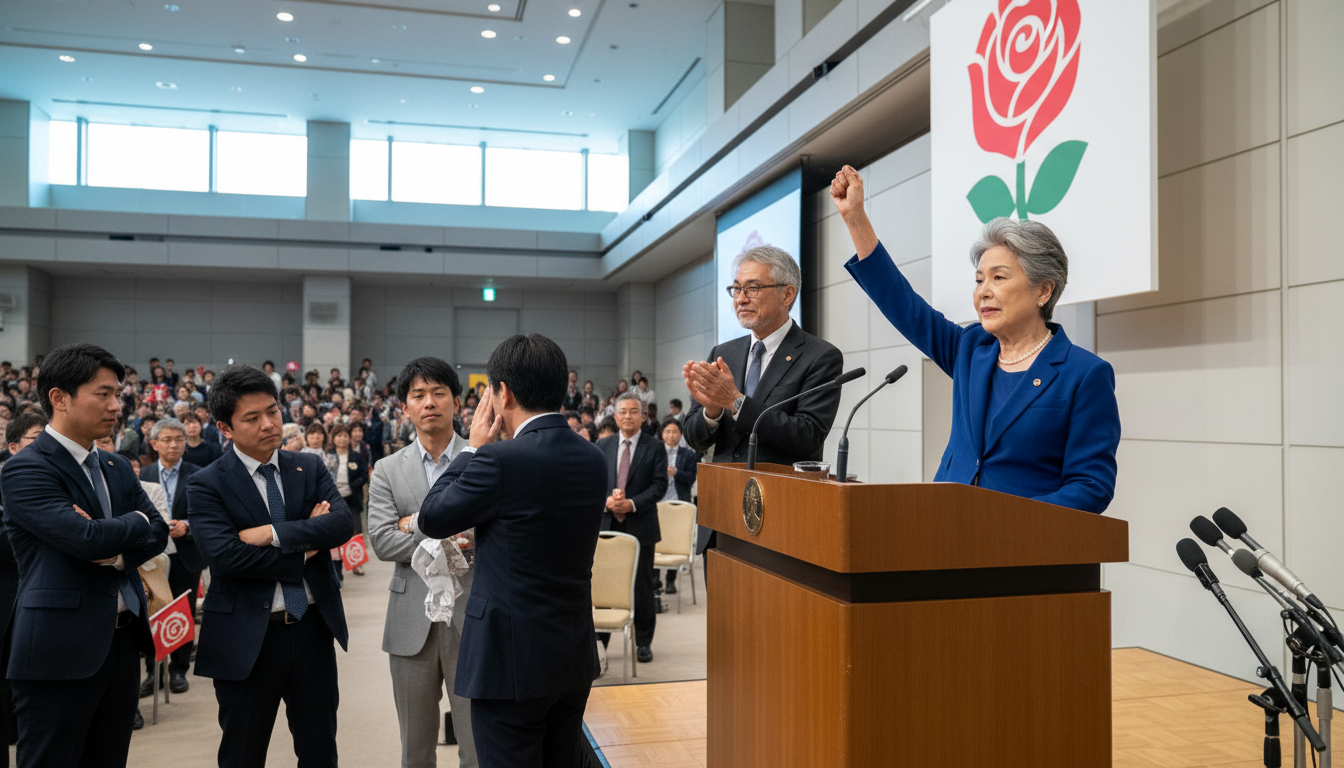
Social Democratic Party re-elects Mizuho Fukushima; Lasalle Ishii named secretary-general amid internal criticism
Social Democratic Party leaders confirmed Mizuho Fukushima’s re-election and appointed Lasalle Ishii as secretary-general at a Tokyo convention on April 29, 2026, while internal disputes over party management surfaced.
Convention confirms leadership change
The Social Democratic Party formally ratified the outcome of its recent leadership vote on April 29, 2026, retaining Mizuho Fukushima as party leader.
Delegates also approved the appointment of Lasalle Ishii, the party’s deputy head, to succeed Ryoichi Hattori as secretary-general, completing a personnel shift announced during the two-day convention held April 28–29 in Tokyo.
Party officials characterized the moves as intended to stabilize operations, but they acknowledged that the vote and surrounding events left unresolved tensions among members and allied organizations.
Controversy over treatment of defeated candidate
A notable and unusual moment at the convention came when a guest speaker publicly criticized the party’s handling of remarks by the defeated leadership candidate, former Upper House lawmaker Yuko Otsubaki (大椿裕子).
Hiroshi Watanabe, chair of the National Trade Union Liaison Council, said the party appeared to have “silenced” Otsubaki’s contributions and described leader Fukushima’s explanations as insufficient.
Watanabe’s comments questioned whether the Social Democratic Party, in its current state, can effectively lead and unify liberal forces, drawing audible reactions from the audience.
Fukushima’s address targeting government policy
In her convention address, Fukushima warned that the government led by Prime Minister Sanae Takaichi posed an unprecedented risk of weakening Japan’s constitution through proposed revisions.
She also criticized the recent policy shift to permit full export of weapons with killing capability, saying such a move risks turning Japan into “a merchant of death.”
Fukushima framed the party’s role as defending constitutional protections and opposing aggressive arms exports, urging supporters that “this is the Social Democratic Party’s moment” to present an alternative.
Questions about party unity and strategy
Despite the leadership confirmation, several delegates and observers said the convention revealed deeper fractures on strategy and internal governance.
Critics noted that procedural disputes during the leadership result announcement, including how candidates’ remarks were handled, aggravated existing mistrust among factions.
Analysts who follow smaller opposition parties warn that visible disunity could hinder the Social Democratic Party’s ability to broaden its base ahead of national and local contests.
Union response and convention atmosphere
The criticism from the National Trade Union Liaison Council underscored tensions between the party and influential labor groups that remain important allies.
Watanabe’s blunt assessment — that explanations offered by party leaders amounted largely to excuses — drew audible approval from parts of the audience and prompted a defensive response from some delegates.
Party insiders said the exchange highlighted the need for more transparent internal dialogue and clearer outreach to labor organizations to rebuild confidence.
Implications for opposition politics
Observers say the developments at the convention may shape coalition dynamics on the left, especially as parties consider how to respond to constitutional revision efforts and shifts in defense policy.
The Social Democratic Party’s insistence on opposing weapon exports and constitutional change positions it distinctly among opposition voices, but internal disputes could complicate efforts to present unified alternatives.
Political strategists will watch whether the new executive configuration under Fukushima and Lasalle Ishii can reconcile differences and mount effective collaboration with labor and other progressive groups.
The party has signaled plans to proceed with a policy and outreach campaign emphasizing constitutional protection and limits on arms exports, but success will depend on repairing internal divisions and restoring trust with allied organizations in the weeks ahead.

